
From the film "Meenaxi, tale of 3 cities".
A song "Noor-un-ala-noor"(Ustad Murtaza Khan, Ustad Qadir Khan)
Lyrics: M.F.Hussain. Music:AR Rahman
chaaro.n taraf chaaro.n taraf nuur-un-alaa nuur-un\-alaa nuur-un-alaa nuur
Everywhere Everywhere!... there is the divine light....light upon light !
ye barq\-e\-tajallii a.ndhero.n ko chiiratii
This Tajali piercing through these darknesses!
(Tajali is arabic and is refered to the Divine sight that was made by Moses on mount Sinai, who used to communicate with God from this mountain without seeing Him)
yahaa.N bhii tuu vahaa.N bhii tu, ye roshanii kyaa roshanii
I find you Here ... I find You There... this Light!.. O WHAT a LIGHT!
tere siwaa ko_ii hai ke puuchhuu.N
Is there a reason to ask if there is anything other than YOU!
a.ndhero.n se puuchhaa to chup ho gaye chup ho gaye
The darkeness became silent when questioned!
ujaalo.n se puuchhaa to sharamaa gaye sharamaa gaye
The brightness became shy when questioned!
pari.ndo.n se puuchhaa kahaa.N parawaaz hai
I questioned the birds ..."where to, do your flights take you?"
Kaamoshii se puuchhaa kahaa.N aawaaz hai
I questioned the silence .."where does sound exist?"
phuulo.n se patto.n se ra.ngo.n seaayii sadaaa
It was then...from the flowers , the leaves and the colors came the same reply:
chaaro.n taraf chaaro.n taraf nuur-un-alaa nuur-un\-alaa nuur-un-alaa nuur
Everywhere Everywhere!... there is the divine light....light upon light !
uThaa_ii chilaman to dekhaa jalawaa teraa
It was when I lifted the veils ...that I saw your miracles!
ba.Dhaayaa qadam to ma.nzil terii ma.nzil terii
It was when I took a step towards You ...that I found the path!
uThaa_ii nazar to suurat terii suurat terii
You were everywhere when I lifted up my eyes!
bha.Nware kii gun\-gun me.n, ka.ngan kii khan\-khan me.n
In the hissing of a moth... in the clanking of the kangan (bracelet) !
aashiq ke tan\-man me.n birahan ke nainan me.n
In the body&spirit of the lover...in the eyes of the birahan
taano.n me.n saragam me.n bas tuu hai tuu hii tuu
In the taans .. in the musical notes..I found you ..only YOU!
dil kii diiwaanagii man kii aawaaragii tuu
You are the passion of my heart ...You the wilderness in my innerself!
duur leke chal tuu kuchh puuchh naa tuu kuchh puuchh naa tuu
Carry me away with You without me questioning...
ji.ndagii ek raaz thii ek raaz hai ek raaz hai
Life was a secret and will remain a secret!
jaan kar hogaa kyaa kis ne hai jaanaa
Who has the answers to it ... who knows!
ko_ii kahe mohabbat ko_ii ibaadat
Some call it love and some call it worship!
diiwaanagii kahe.n chaahe junuu.N chaahat hii terii adaa
Some may call it ecstasy and others passion but ...LOVE is your truest attribute!
chaaro.n taraf chaaro.n taraf nuur-un-alaa nuur-un\-alaa nuur-un-alaa nuur
Everywhere Everywhere!... there is the divine light....light upon light !
ye barq\-e\-tajallii a.ndhero.n ko chiiratii
This Tajali piercing through these darknesses!
yahaa.N bhii tuu vahaa.N bhii tu, ye roshanii kyaa roshanii
I find you Here ... I find You There... this Light!..
O WHAT a LIGHT!
Tuesday, July 8, 2008


Thursday, July 3, 2008
Hesychasm
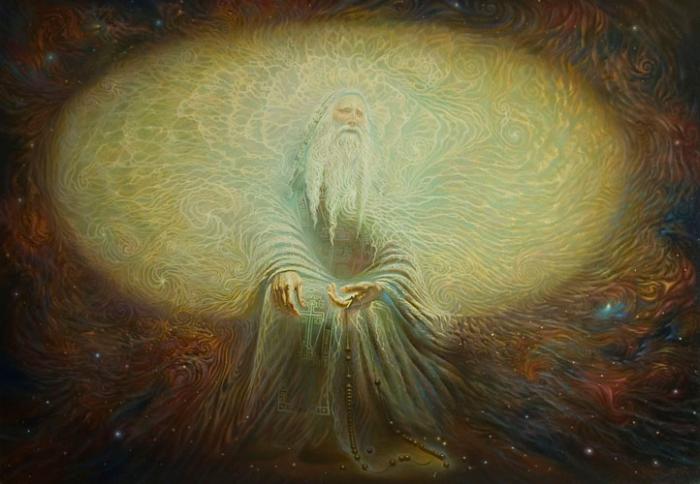
Hesychasm (Greek ἡσυχασμός) is an eremitic tradition of prayer in the Eastern Orthodox Church, and some other Eastern Churches of the Byzantine Rite.
Based on Christ's injunction in the Gospel of Matthew to "go into your closet to pray", Hesychasm in tradition has been the process of retiring inward by ceasing to register the senses, in order to achieve an experiential knowledge of God.
Hesychastic practice bears some resemblance to mystical prayer or meditation in Eastern religions (Buddhism, Hinduism, Jainism and Sufism, compare with yoga), although this similarity is often over-emphasized in popular accounts and generally rejected by actual Orthodox practitioners of Hesychasm. The practice may involve specific body postures and be accompanied by very deliberate breathing patterns. However, these bodily postures and breathing patterns are treated as secondary both by modern Athonite practitioners of Hesychasm and by the more ancient texts in the Philokalia, the emphasis being on the primary role of Grace.
Take up your seat on a high place and watch, if only you know how, and then you will see in what manner, when, whence, how many and what kind of thieves come to enter and steal your clusters of grapes. When the watchman grows weary, he stands up and prays; and then he sits down again and courageously takes up his former task.In solitude and retirement the Hesychast repeats the Jesus Prayer, "Lord Jesus Christ, son of God, have mercy on me, a sinner." The Hesychast prays the Jesus Prayer 'with the heart'—with meaning, with intent, 'for real' . He never treats the Jesus Prayer as a string of syllables whose 'surface' or overt verbal meaning is secondary or unimportant. He considers bare repetition of the Prayer as a mere string of syllables, perhaps with a 'mystical' inner meaning beyond the overt verbal meaning, to be worthless or even dangerous. This emphasis on the actual, real invocation of Jesus Christ marks a divergence from Eastern forms of meditation.
The Great Schema or Megaloschema, worn by seasoned hesychasts:
The Hesychast is to bring his mind into his heart so as to practise both the Jesus Prayer and sobriety with his mind in his heart. The descent of the mind into the heart is taken quite literally by the practitioners of Hesychasm and is not at all considered to be a metaphorical expression. Some of the psychophysical techniques described in the texts are to assist the descent of the mind into the heart at those times that only with difficulty it descends on its own.
Theophan the Recluse's famous sayings:
"God abandons no one. For Him all are children. None are step-children. And the hard occasions and situations - all is sent for our benefit."
"Attention to that which transpires in the heart and proceeds from it - this is the chief activity of the proper Christian life."
"You must watch after yourself."
"Descend with your attention into the heart, stand there before the Lord and admit nothing sinful to enter there. In this is the entire activity of inner warfare."
"Mercilessness to oneself, readiness to perform any favor to others and the surrender of oneself entirely to the Lord with a prayerful abiding in Him - these are the creators of the spiritual life."
"You must kill egoism. If you don't kill it yourself, then the Lord, hammer-blow after hammer-blow, shall send various misfortunes, so as to crush this stone."
"Self-pleasing and self-pity testify that in the heart abides the ego, and not the Lord."The guard of the mind is the practical goal of the Hesychast. It is the condition in which he remains as a matter of course throughout his day, every day until he dies. It is from the guard of the mind that he is raised to contemplation by the Grace of God.
The Hesychast usually experiences the contemplation of God as light, the Uncreated Light of the theology of St Gregory Palamas.
The goal is to acquire, through purification and Grace, the Holy Spirit and salvation. Any ecstatic states or other unusual phenomena which may occur in the course of Hesychast practice are considered secondary and unimportant, even quite dangerous. Moreover, seeking after unusual 'spiritual' experiences can itself cause great harm, ruining the soul and the mind of the seeker. Such a seeking after 'spiritual' experiences can lead to spiritual delusion—the antonym of sobriety—in which a person believes himself or herself to be a saint, has hallucinations in which he or she 'sees' angels, Christ, etc. This state of spiritual delusion is in a superficial, egotistical way pleasurable, but can lead to madness and suicide, and, according to the Hesychast fathers, makes salvation impossible.
The Lord seeks a heart filled to overflowing with love for God and our neighbor; this is the throne on which he loves to sit and on which he appears in the fullness of his heavenly glory. Son, give me thine heart, for in the human heart the Kingdom of God can be contained." ---Saint Seraphim de Sarov
Tuesday, July 1, 2008
Dadu

Dadu Dayal was a saint from Rajasthan in northern India. "Dadu" means brother, and "Dayal" means "the compassionate one". He lived in the second half of the sixteenth century (1544-1603).
The Creator has many and diverse names:
Choose the name that comes to mind; thus do all the saints practice remembrance.
The Lord who endowed us with soul and body-worship Him in your heart ;
Worship Him by that name which best suits the moment.
Wonderful is the Name; it holds the truth of the three worlds.
Considering this, 0 heart, repeat it night and day.
Wonderful is the Name; let the heart never forget Hari.
Let his image dwell in the heart; cherish it with every breath.
When you cherish Him with every breath, one day He will come to meet you.
One sits fearlessly by repeating God's Name;
the Negative Power can never consume him.
When thou ridest the elephant, 0 Dadu,
then dogs bark in vain.
When love and devotion arise,
one is firmly established in blissful meditation.
With the grace of the Master,
he then drinks the divine Nectar, 0 Dadu.
By being dedicated to the Lord,
millions of obstacles are removed.
A tiny spark the size of a mustard seed
burns a huge amount of wood, 0 Dadu.
Impurities and blemishes of the mind
are burnt up in the fire of separation.
The separated lover will now see
the vision of the Beloved, 0 Dadu.
An Outer Guru that is not an Inner Guru, not a Qualified Teacher
The whole world makes an outer display,
whereas the practice of the Saint is within.
This is the difference between the two;
hence no accord is found between them.
A new pot taken from the potter's furnace
may be decorated with many pictures outside;
But of what use will it be to thee,
0 Dadu, without any contents?
Such are the ones who make outer display of religiosity.
From one who bears no outer religious symbols,
but has unfathomable riches within,
Receive the wealth and keep it within
thy heart, 0 Dadu, and be obedient to such a Saint.
There is a great difference between a Saint and a mimic,
the two are as far apart as earth and sky.
The Saint is absorbed in God, whereas
the mimic pins his hopes on the world.
The One alone dwells within my heart,
Day and night I repeat His Name.
The Name of God alone is true;
keep that within thy heart.
Forsake all hypocrisies and cumbrous practices;
this is the teaching of all Saints, 0 Dadu.
My enemy "I" is now dead; now none can slay me.
'Tis I who have slain myself; I have died, arid yet live.
While the thought of self remains, so long are there two.
When this selfhood is destroyed, then there is no second.
Then only will you find the Beloved, when "I" and "mine" are wholly lost.
When "I" and "mine" are no more, then shall you find the pure vision. "I" and "mine" are a load upon the head; you die with the weight of it.…
In front of [the true] I, stands the [false] I; for this reason, He remains hidden.
When I am not, then there is One; when I intrude, then two.
When the curtain of "I" and "Thou" is drawn aside, then do I become as I was [in the Beginning].
I am nothing and can do nothing
Truly even a fool may reach Thee by Thy grace.
Without love all is false, try however hard you may.
The pain of separation is not born of words; desire [for God] is not born of words.
About the Time

"Al-zaman miqdar al-wujud or, “time is the dimension of existence", - Abu al-Barakat.
“The instant of anguish is not a fragment of duration; it is beyond doubt a divine touch of theologal hope, which transfigures our memory forever” - Fakhra Razi.
According to scholar Kalabadhi, when the sufi mystic Al-Hallaj was asked what an instant is, he replied, “It is a breeze of joy (farja) blown by pain, Wisdom is waves which submerge, rise and fall, so that the instant of the sage is black and obscured.”
" While traveling through a forest, Narada asks Lord Vishnu about maya, the illusory world. After a while Vishnu feels thirsty and sends Narada to a nearby village to fetch him some water, where Narada falls in love with a farmer’s daughter and sets up a household. He lives happily with his new family for many years, before a terrible flood wipes out the whole village and he finds himself wandering through the forest. Upon hearing his footsteps, Vishnu says, “O Narada, where have you been? I have been waiting for half an hour.”
Mircea Eliade contends that this is the Hindu myth, an invocation of sacred time that periodically relieves us from the Now ( hal in Arabic) which is considered material or ‘profane’ time. The Hindu concept of time is illustrated well by the myth cited above, and it also serves as a mnemonic to periodically invoke the original rules of the cosmic game. According to the above theory, maya manifests itself through time, the cyclical Kalachakra, and time dilates from human being to gods. Time occurs in differing durations of cycles, in wheels within wheels where one second for a God may be experienced as millennia for a mortal.
While the traditional Muslim sees Time as the twinkling of God’s eye, the Vedic Hindus measured time by the blinking of his own eyes (paramanu, approximately 4 seconds in Vedic metric system). Both Hindus and Muslims invoke sacred time by the use of mantra and azaan, which represent a verbal program for a release from the immediacy of human existence, to a place beyond time and closer to God. They are both followers of a code of conduct based on daily, seasonal or lunar routine, while these may differ greatly in practice. The Muslims worship no idols, and the Hindus have no evidence of any Prophet who started the religion (so they endlessly keep inventing new images to deify). Both religions believe that the universe is in a state of becoming, and imperfection pervades through it all, justifying the temporary presence of evil, towards a final reconciliation. In the case of the Muslim, the reconciliation is a perfect moment, and in the case of the Hindu, it is the self-assembly of God’s body (the original universe). If everything happens with the decree and sanction of Allah for a Muslim, it also happens for Hindus because only one God is the player of the cosmic game in Hinduism:
I am Mârgasirsha among the months, the spring among the seasons, of cheats, I am the game of dice, I am the greatness of the great, I am victory, I am industry, I am the goodness of the good.Bhagawad Gita
And yet, in spite of an all-powerful God, both Islam and Hinduism allow a human being some free will in changing his destiny. A Hindu can keep earning good karma from his actions and ascend the levels in the game of life, whereas a Muslim can indulge himself in innovations (tajaddudat) and thereby receive a positive feedback in God’s will leading him closer to Oneness with Him.
Yoga Kundalini Upanishad - Part 1

Yoga Kundalini Upanishad belongs to Yajurveda and deals with Kundalini Yoga practices. Kundalini Yoga is considered as a practice of Tantric origin. Possibly during later period of fusion of Upanishadic and Tantric systems it got absorbed in Upanishads also. Without going into the debate of its origin it remains a fact that awakening sleeping Kundalini marks a very important phase in the spiritual life of a seeker. The Yoga Kundalini Upanishad describes awakening of Kundalini in esoteric language just like many other ancient texts on the subject. The teachings of Yoga Kundalini Upanishad are discussed next.
Saraswatichalana
Mind stuff is a result of two ingredients namely desires and prana. The prana can be controlled by moderate diet, Yoga postures and Shaktichalana.
A Yogi should consume sweet and nutritious food. Half of the stomach should be filled with food, one quarter with water and the remaining quarter should be left empty to please Shiva, the Lord of Yogis. This is moderate diet.
Place right foot on the left thigh and left thigh on the right thigh. This is called as Padmasana and destroys all sins.
Place one heel below the Muladhara region and the other over it i.e. Swadhisthana region. Stunk, neck and head should be in straight line. This is called as Vajrasana.
A Yogi should take the Kundalini from Muladhara to Sahasrara. This practice is called as Shaktichalana.
He should pass the Kundalini through Swadhisthana Chakra, Manipura Chakra, Anahata Chakra, Vishudhi Chakra and Ajna Chakra.
Shaktichalana can be mastered with the help of two things - Saraswatichalana and Pranayama.
Saraswatichalana refers to awakening of Saraswati Nadi which is also called as Arundhati. Kundalini can be awakened only by rousing the Saraswati Nadi.
Normally during exhalation prana goes out 16 digits and during inhalation 12 digits. Thus 4 digits are lost during breathing. Sitting in Padmasana one should lengthen inhalation by 4 digits. Thus inhalation and exhalation are made equal. This awakens the sleeping Kundalini.
A Yogi should awaken the Saraswati Nadi with the help of lengthened breath and holding both the lands near ribs and shaking the Kundalini from right to left again and again. He should do so for 48 minutes. He should then force the Kundalni into Sushumna. Along with Kundalini prana also finds its way in Sushumna.
Then he should compress his neck and expand the navel region. Saraswati is then to be shaken and prana is taken above the chest. Because of the compression of the neck prana moves above chest.
This way Saraswati who has sound in her womb should be shaken every day.
Types of Pranayama
Prana is the vayu that circulates throughout the body. Holding the prana inside is called as Kumbhaka. Kumbhaka is of two types viz. Sahita and Kevala. Till Kevala Kumbhaka is not attained one should practice Sahita Kumbhaka.
There are four types of Pranayama - Suryabheda, Ujjayi, Sitali and Bhastrika.
Select a place that is pure and free of obstructions. It should be free from cold, fire and water. Place seat to such a place which is not too high or too low. Now sit in Padmasana and perform Saraswatichalana. Slowly inhale the breath through the right nostril. Hold it as per capacity and then exhale through the left nostril. This destroys all abnormalities caused by Vayu. It also destroys worms in the intestine. This process should be done again and again. This is called Suryabheda.
Closing the mouth inhale through both the nostrils. Hold it in the space between the heart and neck. Then exhale through left nostril. This pranayama removes heat caused in the head and also the phlegm. It destroys all diseases (including dropsy), purifies the body and increases the gastric fire. It removes all abnormalities in dhatus. This is called Ujjayi and can be practiced walking or standing.
Inhale the breath over the tongue making hissing sound. Retain it to capacity. Then slowly exhale through both the nostrils. This is called Sitali Kumbhaka. It cools the body, destroys dyspepsia, diseases of spleen, bile, fever, thirst and poison.
Sit in Padmasana with trunk and neck erect. Closing the mouth exhale through both the nostrils. Then inhale slightly up to the neck such that the breath fills between neck and skull. Just as the bellows of black smith move the air in and out of the body. When you get tired inhale through the right nostril. Perform Kumbhaka and then exhale through the left nostril. This pranayama removes inflammation of throat, increases gastric fire. The practitioner of Bhastrika knows Kundalini. It makes the practitioner pure, destroys sins and removes phlegm which creates obstacle at the door of Sushumna. It pierces the three Granthis (knots) namely Bramha Granthi, Vishnu Granthi and Rudra Granthi.
Bandhas
A Yoga aspirant should then practice the three Bandhas viz. Mula Bandha, Uddiyana Bandha and Jalandhara Bandha.
Apana has a tendency to move downwards. This tendency is reversed by contracting anal muscles. This is called Mula Bandha. When the raised Apana reaches Agni it gives rise to psychic heat. This heat awakens the sleeping Kundalini. She becomes straight making a hissing sound and enters Shushumna. Hence, Yogis should practice Mula Bandha often.
In the state of Kumbhaka Uddiyana Bandha is to be performed. It is called so because prana flies inside Sushumna because of this Bandha.
Sitting in Vajrasana hold toes by hand. Press Kanda and region near ankles. As the prana reaches navel it removes impurities and diseases. Hence, this should be practiced often.
At the end of inhalation practice Jalandhara Bandha. It is performed by contracting neck on the chest and acts as a barrier to the flow of prana upwards. Assuming this position a Yogi should perform Saraswatichalana and Pranayama.
On the first day a Yogi should practice Kumbhaka four times. On the second day it should be done ten times each. On the third day it should be done twenty times. After this it should be practiced with the three Bandhas increasing the number by five each day.
Obstacles to Yoga Practice
Diseases are born because of seven causes. They are - sleeping during the day time, late vigils, excess sexual activities, moving in crowd, wrong diet, restraining excretion of urine and faces and too much mental activity.
A Yogi suffering from any of these diseases thinks that his practice is the cause of these diseases and discontinues the practice. This is the first obstacle in Yoga. The other obstacles are - doubt about the practice, confusion, laziness, over sleeping, slavery of senses and delusion, material enjoyment, lack of faith and failure to attain truth of Yoga. A wise Yogi should avoid all these ten obstacles.
With a concentrated mind the Pranayama should be performed daily. Then the mind rests in Sushumna and Prana becomes stable. One becomes Yogi only when impurities of the mind are destroyed and prana enters Sushumna.
After removing all the impurities from Sushumna a Yogi should force Apana to move upwards by the practice of Mula Bandha. The raised up Aprana mixes with Prana and they reach the sleeping Kundalini. Heated by fire and shaken by Prana the Kundalini stretches its body in the Sushumna.
Piercing the three knots
The awakened Kundalini pierces Bramha Granthi which is representation of Rajoguna. Like lightening it flashes at the door of the Sushumna.
Then Kundalini goes to Vishnu Granthi at the heart center. Then to Rudra Granthi and finally to Ajna Chakra.
After piercing the three Granthis she goes to mandala of the moon. The moisture produced by the moon in the Anahata Chakra is dried up.
Because of the flow of Prana the blood in the sun region becomes bile because of heat. When it reaches the moon it becomes of the nature of phlegm.
The white moon also gets quickly heated. The awakened Kundalini moves up and shower of nectar starts flowing heavily.
By drinking this nectar mind of the Yogi moves away from sensual enjoyments. The Yogi is established in Self. He attains the highest state and peace.
Union of Shiva and Shakti
The awakened Kundalini then goes to Sahasrara. It gives up the eight forms of the Prakriti namely earth, water, fire, air, eather, mind, intellect and ego.
After embracing eyes, mind, prana and others the Kundalini goes to Shiva and dissolves herself in the Sahasrara.
The rajas-shukla bindu goes to Shiva along with vayu. Prana and Apana become equal.
Prana flows in all things like brightness of gold. The breath also dissolves itself.
Prana and Apana also dissolve themselves in Shiva situated in the Sahasrara. Since they are now balanced their upward and downward movement stops.
The prana and vital airs spread in the body of the Yogi just as gold in heated crucible.
True Knowledge
The body of such a Yogi becomes very subtle state of Bramhan. His gross body made up of five elements is transformed in a subtle form of Paramatman.
The Truth that is released only in the state of Samadhi and is free from impurities.
The one which is absolute consciousness, which is "I" in all beings, the Bramhan, the subtle form of That is the Truth behind all the things.
Like the false impression of snake in a rope, the idea of release from life and Samsara is a delusion.
Everything that appears is unreal. Everything that is absorbed is unreal. Like the false idea of silver in the shell of a pearl, so is the idea of men and women.
The microcosm and macrocosm are one and the same.
Samadhi
The Kundalini is like a thread in the lotus. she is magnificent. She is biting the upper end of its body, at the root of the lotus, the Muladhara with her mouth.
She resides in the hole of Bramhanadi of Sushumna taking her tail in the mouth.
A Yogi having assumed Padmasana, performing Mula Bandha makes the Vayu move upwards which his mind absorbed in Kumbhaka. Because of the Vayu the fire comes to Swadhisthana.
Because of the Vayu and fire the Kundalini pierces open the Bramha Granthi and then Vishnu Granthi.
She then pierces Rudra Granthi. After that, she pierces all the six Chakras. She then dissolves with Shiva in the Sahasrara. This is the highest state. This state alone can give supreme bliss.
-- End of Chapter 1 --
Thursday, June 26, 2008
A Chinese story


Diego Rivera "Stone Mason"
The Stone Cutter
There was a stonecutter, who was dissatisfied with himself and with his position in life.
One day, he passed a wealthy merchant's house, and through the open gateway, saw many fine possesions and important visitors. "How powerful that merchant must be!" thought the stonecutter. He became envious, and wished that he could be like the merchant. Then he would no longer have to be a mere stonecutter.
To his great surprise, he suddenly became the merchant, enjoying more luxuries and power than he had ever dreamed of, envied and detested by those less wealthy than himself. But soon a high official passed by, carried in a sedan chair, accompanied by attendants, and escorted by soldiers beating gongs. Everyone, no matter how wealthy, has to bow low before the procession. "How powerful that official is!" he thought. "I wish that I could be a high official!".
He became the official, carried everywhere in his sedan chair, feared and hated by all around him. It was a hot summer day, and he felt very uncorfotable in the sticky sedan chair. He look up at the sun. It shined proudly in the sky, unaffected by his presence. "How powerful the sun is!" he thought. "I wish that I could be the sun!".
He became the sun, shining fiercely down on everyone, until a huge blak cloud moved between him and the earth, so that his light could no longer shine on everything below. "How powerful that storm cloud is!" he thought. "I wish that I could be that cloud!".
He became the cloud, flooding the fields and villages, shouted at by everyone. Pretty soon he found that he was being pushed around by some great force and realised that it was the wind. "How powerful the wind is!" he thought. "I wish I could be the wind!"
Then he became the wind, blowing tiles off the roofs of houses, uprooting trees, hated and feared by all below him. But soon he ran up against something that would not move, no matter how hard he tried. A huge towering stone. "How powerful that stone is!" he thought. "I wish I could be the stone!".
He became the stone, more powerful than anything else on earth. But as he stood there, he heard the sound of a hammer pounding a chisel into him, felt himself being changed. "What could be more powerful than I, the stone?" he thought. He looked down and saw far below him the figure of a stonecutter.
Schools of Vedanta

By Swami Nikhilananda
According to Sadananda (author of Vedantasara), Vedanta includes the Upanishads, the Brahma-Sutras, the Bhagavad Gita and the commentaries elucidating these texts.
The texts of Vedanta have, in the main, given birth to two sub-systems of philosophy, namely the Non-dualism or Absolutism of Sankaracharya and the Theism of Ramanuja, Madhvacharya and other philosophers. According to the Non-dualist, Brahman or Pure Consciousness, is the only Reality the universe of names and forms is unreal, and man, in his true essence, is one with Brahman.
The Theists accept a Personal God as Ultimate Reality. He is related to the universe and embodied souls in varying degrees. According to Ramanuja, the upholder of Visistadvaita, or Qualified Non-dualism, the Reality is Brahman; but the individual souls and the universe are also real, being parts of Brahman or modes of His manifestation. Brahman, with the universe and the individual souls, constitutes the whole of Reality. This is illustrated by the philosophers of this school with the metaphor of the pomegranate fruit. The seeds are the living souls and the rind is the universe. One cannot think of the fruit without the seeds and the rind.
According the Madhvacharya, the Dualist, the Universe and the living souls are separate from God. While the universe is a material entity, the souls are spiritual in nature. The souls, though separate from God, cannot exist without Him. Their existence is entirely dependent upon God. Madhvacharya speaks of living beings as the servants of God.
Sri Sankara, Sri Ramanuja and Sri Madhva are the most illustrious commentators on the Vedanta Sutras (Brahma-Sutras). These commentators have tried to establish theories of their own, such as Advaita-Vada (unqualified non-dualism or uncompromising or rigorous monism), Visishtadvaita-Vada (differentiated or qualified monism) and Dvaita-Vada (strict or rigorous dualism). Sankaracharya had in view, while preparing his commentary, chiefly the purpose of combating the baneful effects which blind ritualism had brought to bear upon Hinduism.
Dualism (Dvaita), Qualified Monism (Visishtadvaita) and Monism (Advaita) are the three main schools of metaphysical thought. They are all stages on the way to the Ultimate Truth, viz., Para-Brahman (the Supreme Reality). They are rungs on the ladder of Yoga. They are not at all contradictory. On the contrary, they are complimentary to one another. These stages are harmoniously arranged in a graded series of spiritual experiences. Dualism, Qualified Monism, Pure Monism – all these culminate eventually in the Advaita Vedantic realisation of the Absolute or the Transcendental Trigunatita Ananta Brahman.
Madhva said: "Man is the servant of God", and established his Dvaita philosophy.
Ramanuja said: "Man is a ray or spark of God", and established his Visishtadvaita philosophy.
Sankara said: "Man is identical with Brahman or the Eternal Soul"and established his Kevala Advaita philosophy.
The Dvaitin wants to serve the Lord as a servant. He wishes to play with the Lord. He wishes to taste the sugar-candy.
A Visishtadvaitin wants to become like Lord Narayana and enjoy the divine. He does not wish to merge himself or become identical with the Lord. He wishes to remain as a spark. A Jnani (jnana = knowledge) merges himself in Brahman. He wishes to become identical with Brahman. He wants to become the sugar-candy itself.
People have different temperaments and different capacities. So, different schools of philosophy are also necessary. The highest rung is Advaita philosophy. A Dualist or Qualified Monist eventually becomes a Kevala Advaitin.
Different Conceptions of Brahman - only different approaches to the Reality.
Nimbarkacharya reconciles all the different views regarding the Lord taken up by Sankara, Ramanuja, Madhva and others, and proves that their views are all true with reference to the particular aspect of Brahman dealt with by them, each in his own way. Sankara has taken Reality in Its transcendental aspect, while Ramanuja has taken It in Its immanent aspect, principally; but Nimbarka has adjusted the different views taken by the different commentators.
Sri Sankaracharya, Sri Ramanujacharya, Sri Madhvacharya, Sri Vallabhacharya and Sri Nimbarkacharya – all were great souls. We cannot say that Sri Sankara was greater than Sri Ramanuja, or Sri Vallabha was greater than Nimbarka, etc. All were Avatara Purushas. Each one incarnated himself on this earth to complete a definite mission, to preach and propagate certain doctrines which were necessary to help the growth of certain type of people, who flourished at a certain period, who were in a certain stage of evolution.
All schools of philosophy are necessary. Each philosophy is best suited to a certain type of people. The different conceptions of Brahman are but different approaches to the reality. It is extremely difficult, rather impossible, for the finite soul to get – all at once – a clear conception of the Illimitable or Infinite Soul, and more so, to express it in adequate terms. All cannot grasp the highest Kevala Advaita philosophy of Sri Sankara all at once. The mind has to be disciplined properly before it is rendered as a fit instrument to grasp the tenets of Sri Sankara’s Advaita Vedanta.
Sunday, June 22, 2008
Everything is the Face of God.

It is related in Muhammad Sa’id al-Jamal ar-Rafai as-Shadhuli’s eloquent book, Music of the Soul, that at the time he was a disciple of Sidi ‘Abd ar-Rahman, may God be well pleased with them both, there was a troublesome old man in Damascus who everyday would throw stones at the zawiyya, the Sufi lodge. Each time the incident of stone throwing happened, his guide would say, “Send him mercy. If he wants food, give him food. If he wants clothes, give him clothes. If he wants money, give him money. Give him what he wants.”
When he, according to the advice of his guide, provided for the old man, he would gather his sons and would throw more stones at the zawiyya.
He asked himself, “What is the wisdom in this?” Then he would again go to this old man and gave him some food and some money and some clothes from his guide, but at the same time he felt something very strong about this person. His guide said to him, “There are many messages when this old man throws stones at the zawiyya.”
Then one day the old man became sick and the eminent guide sent his disciple to him. When he arrived at his house, the old man woke up and asked, “Who is there?” He mentioned his name and the old man began to weep and he started to say Astaghfirullah! (seeking forgiveness from Allah). And after some days, he came to live in the zawiyya. And he became a holy student under the guide.
When Sidi as-Shadhuli later wrote down this story, this man was already one hundred and five years old. Later when he met him in Amman, Jordan, the old man said, “Sidi, excuse me for throwing stones at the zawiyya. But if I had not hit the zawiyya, I would not have reached God. How could I have known the guide and the Way, if I had not thrown stones?” The guide saw the wisdom of his actions and knew that this old man was one of his students.
This story has a picture illustrating it. The picture is of the date tree. “Be like this tree,” advises Sidi. “When any person throws something to hit the date tree, it gives him back sweets. This is the right way.”
“If anyone makes something bad for you, or speaks in an unkind way, understand Who speaks and Who hits. Be sweet and give to everyone who wants sweets, because after the fire is the garden and after the darkness is light. It is necessary to see within everything, to see where it is coming from and to return it to God. Be polite! Everything is the Face of God.”
Wednesday, June 18, 2008
René Guénon

René Guénon (November 15, 1886 – January 7, 1951) was a French author and intellectual who remains an influential figure in the domain of metaphysics, having written on topics ranging from metaphysics, sacred science and traditional studies to symbolism and initiation. He gave his agreement to the creation in France of a Masonic lodge of traditional nature, whose name La Grande triade ("The Great Triad"). He died on January 7, 1951, in Cairo, Egypt, after having said his last words "El nafass khalass!" ("the soul is going away") and "Allah! Allah!"
Some fundamental terms and notions
Metaphysics
It may now be stated that metaphysics [...] is essentially the knowledge of the Universal, or, if preferred, the knowledge of the principles belonging to the universal order, which moreover alone can validly lay claim to the name of principles; but in making this statement, we are not really trying to propose a definition of metaphysics, for such a thing is a sheer impossibility by reason of that very universality which we look upon as the foremost of its characteristics, the one from which all the over are derived. In reality, only something that is limited is capable of definition, wheras by definition metaphysics is on the contrary by its very nature absolutely unlimited, and this plainly does not allow our enclosing it in a more or less narrow formula [...]
Identity of the knowing and being
Metaphysics affirms the fundamental identity of knowing and being [...] and since this identity is essentially implied of the very nature of intellectual intuition, it not merely affirms it but realizes it as well.
Initiation and mysticism
Today the esoteric or initiatic domain and the mystical domain, - or, if one prefers, their respective points of view - are often confused [...]. it is currently the fashion so to speak among those with limited horizons to construe all Eastern doctrines as 'mystical', including those that lack even a semblance of the outward aspects that could justify such an attribution [...]. [...] in everything pertaining to initiation there is really nothing vague or nebulous, for on the contrary it is as precise and 'positive' as can be, so that initiation by its very nature is in fact incompatible with mysticism.
The Self
The 'Self' is the transcendant and permanent principle of which the manifested being, the human being, for example, is only a transient and contingent modification, a modification which, moreover, can in no way affect the principle [...] The 'Self', as such, is never individualized and cannot become so, for since it must always be considered under the aspect of the eternity and immutability which are the necessary attributes of pure Being, it is obviously not susceptible of any particularization, which would cause it to be 'other that itself'. Immutable in its own nature, it develops the indefinite possibilities which it contains within itself, by a relative passing from potency to act through an indefinite series of degrees. Its essential permanence is not thereby affected, precisely because this process is only relative, and because this development is, strictly speaking, not a development at all, except from the point of view of manifestation, outside of which there is no question of succession, but only of perfect simultaneity, so that even what is virtual under one aspect, is found nevertheless to be realized in the 'eternal present'.
Paramâtmâ, individuality, personality
[...] Previously, on the contrary [i.e. prior to the theosphists], even in the West, whenever any distinction has been made between these two terms ['individuality' or 'ego' and 'personality'] the personality has always been regarded as superior to individuality [...] The 'Self' [...] considered in relation to a being, is properly speaking the personnality; it is true that one might restrict the use of this latter word to the 'Self' as principle of the manifested states, just as the 'Divine Personality', Ishwara, is the Principle of universal Manifestation; but one can also extend it analogically to the 'Self' as principle of all states of the being, both manifested and unmanifested. The personality is an immediate determination, primordial and non-particularized, of the principle which in Sanskrit is called Atmâ or Paramâtmâ, and which, in default of a better term, we may call the 'Universal Spirit', on the clear understanding, however, that in this use of the word 'spirit', nothing is implied that might recall Western philosophical conceptions, and, in particular, that is not turned into a correlative of 'matter', as the modern mind is inclined to do, being subject in this respect, even though unconsciously, to the influence of Cartesian dualism.
Universal and individual
The 'Self', in relation to any being whatsoever, is in reality identical with Atmâ, since it is essentially beyond all distinction and all particularization; and that is why, in Sanskrit, the same word âtman, in cases other than the nominative, replaces the reflexive pronoun 'itself'. The 'Self is not therefore really distinct from Atmâ, except when one considers it [...] in relation to a certain definite state of being, such as the human state [...]. In this case, moreover, the 'Self' does not really become distinct from Atmâ in any way, since [...] it [...} cannot be affected by the point of view from which we regard it [...]. What should be noted is that to the extent that we make this distinction, we are departing from the direct consideration of the 'Self' in order to consider its reflection in human individuality [...]. The reflection in question determines what may be called the center of this individuality; but if isolated from its principle, that is, from the 'Self', it can only enjoy a purely illusory existence, for it is from that principle that it derives all its reality, and it effectually possesses this reality only through participation in the nature of the 'Self', that is, insofar as it is identified therewith by universalization.
The personality [...] belongs essentially to the order of principles in the strictest sense of the word, that is, to the universal order [...]. [The] following table [...] sets forth the essential distinctions in this connection [...]:

Samâdhi and ecstasy
[...] let us also point out the impropriety of translating samâdhi as "ecstasy", this latter being all the more irksome as it is normally used in Western languages to designate mystical states, that is to say something of an altogether different order, with which it must not be confused; its etymological signification moreover is "to go out of oneself" (which suits very well the case of mystical states), wheras what the term samâdhi designates is quite to the contrary a "return" of the being into its own Self.
Subscribe to:
Posts (Atom)
