Thursday, September 6, 2012
Rudra Kavacham
asyashreerudrakavacha sthothra mahaamamthrasya dhurvaasaarushih anushtupchandhah thriambaka rudro devathaa om beejam hreem shakthih kro keelakam mama manobheeshta siddhyarthe jape viniyogah hraamithyaadhi shaddheerghai shshadanganyaasah
Dhyaanam :
shaantham padhmaasanam shashidharamakutam pamchavakthram thrinethram /
shoolam vajram cha khadgam parushamabhayadham dakshabhaage vahastham //
naagampaasham cha ghannaam praLayahuthavaham saamkusham vaamabhaage /
naanaalamkaarayuktham sphatika maninibham parvatheesham namaami //
Durvaasaa uvaacha :
pranamya shirasaa devam svayambhum parameshvaram /
ekam sarvagatham devam sarvadevamayam vibhum //
rudravarma pravakshyaami amgapraanasya rakshaye /
ahoraathramayam devam rakshaartham nirmitham puraa //
rudro me chaagrathah paathu paathu parshvau hara sthathaa /
shiro me eeshvarah paathu lalaatam neelalohithah //
nethrayosthryambakah paathu mukham paathu maheshvarah /
karnayoh paathu me shambhurnaashikaayaam sadhaashivah //
vaageeshah paathu me jihvaa moshtau paathvambikaapathih /
shreekantah paathu me greevaam baahoomshchaiva pinaakadhruth //
hrudhayam me mahaadeva eeshvareevyaath sthanaantharam /
naabhim katim savakshashcha paathu sharva umaapathih //
bhaahumadhyaamtharam chaiva sookshmaroopassadhaashivah /
sarvam rakshathu sarvesho gaathraani cha yathaakramam //
vajrashakthidharam chaiva paashaamkushadharam thathaa /
gandashooladharam nithyam rakshathu thridhasheshvarah //
prasthaaneshu padhe chaiva vrukshamoole nadheethate /
sandhyaayaam raajabhavane viroopaakshasthu paathumaam //
sheethoshnaa dhatha kaaleshu thuhina dhrumakamtake /
nirmanushye samemaarge thrrhi maam vrushabhadhvaja //
ithyetha dhrudrakavacham pavithram paapanaashanam /
mahaadeva prasaadhena dhurvaaso munikalpitham //
mamaakhyaatham samaanenana bhayam vimdhathi kvachith /
praapnothi paramaarogyam punya maayushyavardhanam //
vidhyaarthee labhathe vidhyaam dhanaarthee labhathe dhanam /
kanyaarthe labhathe kanyaam nabhayam vimdhathe kvachith //
aputhro labhathe puthram mokshaarthee mokshamaapnuyaath /
thraahi thraahi mahaadeva thraahi thraahi thrayaamaya //
thraahi maam paarvatheenaatha thraahi maam thripuraamthaka /
paasham khatvaamgadhivyaasthram thrishoolam rudramevacha //
namaskaromi devesha thraahi maam jagadheeshvara /
shathrumadhye sabhaamadhye graamamadhye gruhaamthare //
gamanaagamane chaiva thraahi maam bbhakthavathsala /
thvam chiththam thvam maanasam cha thvam budhdhi sthvam paraayanam //
karmanaa manasaachaiva thvam budhdhishcha yathaa sadhaa /
jvarabhayam chimdhi sarvajvarabhayam chimdhi grahabhayam chimdhi //
sarvashathroonni varthyaapi sarvavyaadhi nivaaram /
asyarudralokamsagachchathi shree rudralokamsagachchathyonnama ithi //
ithi shree skaandapuraane durvaasah proktham shree rudrakavacham.
Translation:
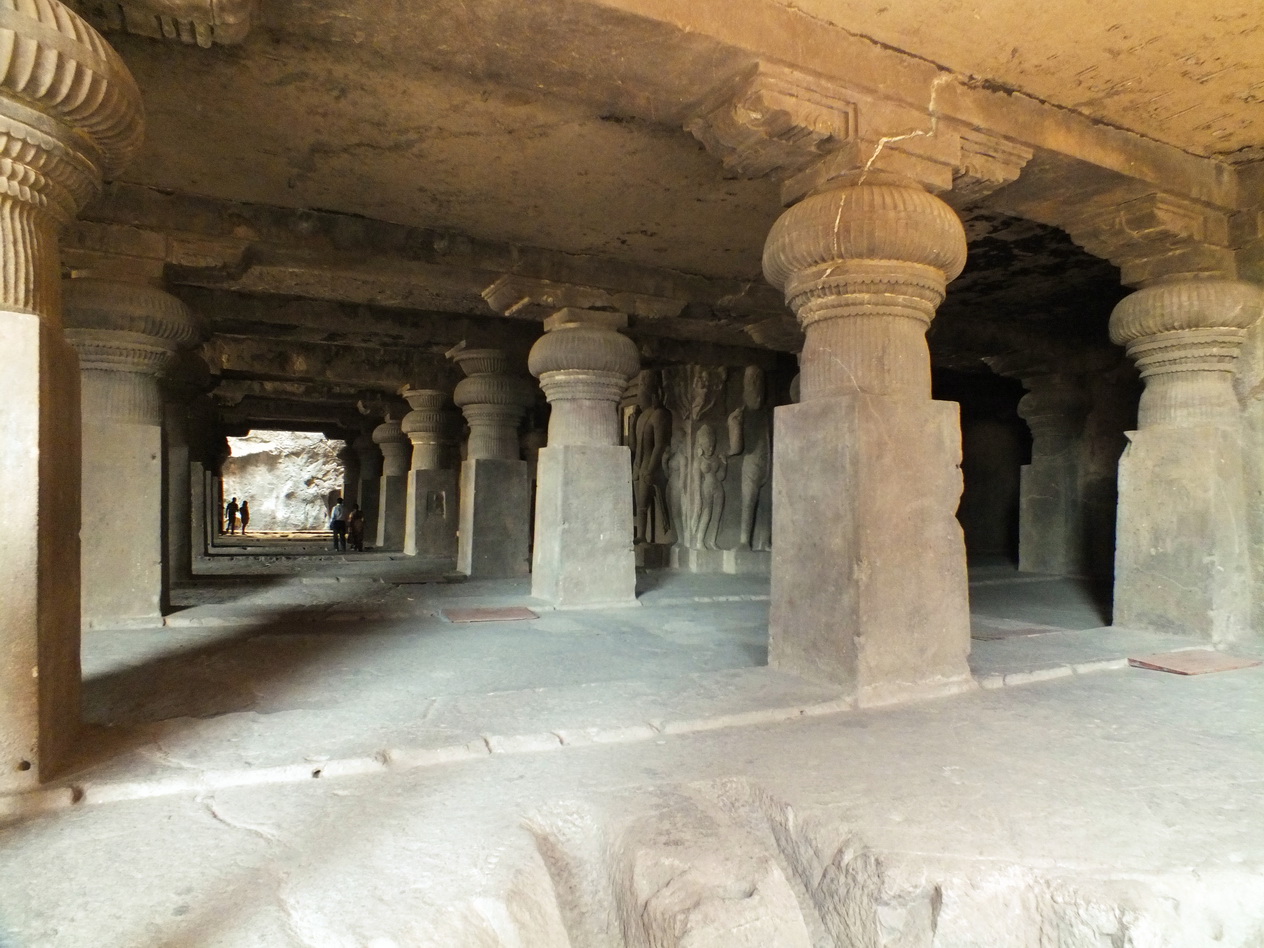
Dhumar Lena - Cave 29 of Ellora
Ravananugriha-murti: Shiva and Parvati sitting on Mount Kailash while the Demon Ravana is shaking him.
This is a continuation of the story about Ellora caves, begun here.
Dhumar Lena, is said to be influenced by the pattern of caves at Elephanta near Bombay, but this cave is a finer and larger than that of Elephanta, which it resembles. It is certainly amongst the most imposing on the site and dates to the late sixth century.
Even the first sight at an input in a cave illustrates the perfection to which the Hindus attained in cave architecture.

Panel showing Andhakasura-vadha-murti of Shiva. He is represented as killing the demon Andhakasura. Shiva is standing in alidhasana and holds a spear with the demon at its end in his hand. It is said that every drop of Andhakasuras blood touching the ground would create another mighty demon.
Uma-Maheshvara playing dice. Shiva holds in one of his hands a serpent, with the third heholds the left hand of Parvati, with the fourth he is taking the dice from the hand of Parvati.
Sanctum sanctorum of the cave has four entrances and each have two guardians on either side. When you approach to it even among day noise you can enter it in inner silence. Probably so great things took place in these silent caves and so fine people filled with their spirit which shone in this temple can still be felt.
This is a continuation of the story about Ellora caves, begun here.
Dhumar Lena, is said to be influenced by the pattern of caves at Elephanta near Bombay, but this cave is a finer and larger than that of Elephanta, which it resembles. It is certainly amongst the most imposing on the site and dates to the late sixth century.
Even the first sight at an input in a cave illustrates the perfection to which the Hindus attained in cave architecture.

Panel showing Andhakasura-vadha-murti of Shiva. He is represented as killing the demon Andhakasura. Shiva is standing in alidhasana and holds a spear with the demon at its end in his hand. It is said that every drop of Andhakasuras blood touching the ground would create another mighty demon.
Kalyanasundara-murti. A scene depicting Kalyanasundara - the wedding of Shiva and Parvati. The couple are often depicted performing the panigrahana ("accepting the hand") ritual of a Hindu wedding, where the groom accepts the bride by taking her right hand in his hand.
Sanctum sanctorum of the cave has four entrances and each have two guardians on either side. When you approach to it even among day noise you can enter it in inner silence. Probably so great things took place in these silent caves and so fine people filled with their spirit which shone in this temple can still be felt.
OM NAMAH SHIVAYA
Ha Raham (God Have Mercy)
Mecca Masjid, Hyderabad 2012
Beautiful sufi song "Ha Raham (Mehfuz)" from film "Aamir" composed by Murtuza-Qadir, Amitabh and Amit Trivedi.
Aani jaani… hai kahaani…
The stories of life will keep coming and going
Bulbule si… zindgaani…
Life is nothing but a bubble ready to burst
Banti kabhi bigadti…
Forming, and sometimes deflating
Tez hawa se ladti, bhidti…
Fighting with and entangled in the strong winds
Ha raham, ha raham, farma e-Khuda…
God Have Mercy, Remember Him only
Mehfuz har kadam karna e-Khuda, e-Khuda
He’ll make sure each step you take is a safe one
Saanson ki sooti… dor anoothi…
This strange string of breaths, like cotton beads
Jal jayegi… jal jayegi…
It will burn away one day, will burn away
Band jo laaye the, haath ki muthhi…
The closed fist with which one entered this world
Khool jayegi
It will open up forever
Armaan kare kayaa ye ujlee… mitti mein mil jayegi…
The false flashes of one’s materialistic wishes will vanish into dust someday
Chaahe jitni shamaayein raushan kar le… dhoop to dhal jayegi, jayegi…
No matter how many lamps you light, the light of life will die one day
Ha raham, ha raham, farma e-Khuda
God Have Mercy, Remember Him only
Mehfuz har kadam karna e-Khuda, e-Khuda
He’ll make sure each step you take is a safe one
Sone chamak mein, sikko khanak mein…
In the shining pieces of gold, and in the clinkering of coins
Milta nahi
One can’t find Him
Dhool ke zarron mein, dhoonde koi tu…
But if one looks even in the dust particles
Milta wahin...
One will find Him there
Kya majaal teri marzee ke aage… bando ki chal jayegi…
No one is powerful enough to act against Your will
Thaame ungli jo tu kathputli bhi… chaal badal jayegi, jayegi..
You catch hold of a puppet’s finger,even it would change it’s way
Ha raham, ha raham, farma e-Khuda…
God Have Mercy, Remember Him only
Mehfuz har kadam karna e-Khuda, e-Khuda
He’ll make sure each step you take is a safe one
Ha raham, ha raham, Khuda, Khuda
God Have Mercy, Remember Him only and Him only
Wednesday, September 5, 2012
Kalika Kavacham
Om asya Sri Kalika kavachasya Bhairava rishi, anushtup Chanda, sri Kalika devatha , Shatru samharattham jape viniyoga
8. Dhyayeth kalim Maha mayaam, trinethraam bahu roopineem,
Chathur bhujaam lalajihwam, poorna chandra nibhananaam.
9. Neelothpala dala shyaamaam, shathru sanga vidharineem,
Nara mundam thadha gadgam, kamalam cha varam thadha.
10. Nirbhayaam Raktha vadanaam, damshtrali ghora roopineem,
Sa aatahasa asana sthudhaam, devim sarvadaan cha digamaram.
11. Savasana sthithaam kalim munda mala vibhooshithaam,
Ithi dhyathwaa Maha Kalim thasthu kavacham padeth.
Kavacham
12. Om Kalika ghora roopa, sarva kama phala pradha shubha,
Sarva deva sthutha devi shathru nasam karothu may.
13. Om hreem hreem roopineem chaiva,
Hraam hreem hraam roopineem thadha,
Hraam hreem kshom kshoum swaroopa saa,
Sadaa shathroon vidharayeth.
14. Sree hreem iym roopini, bhava bandha vimochani,
Hoom roopini, maha kali, rakshasmaan devi Sarvadhaa.
15. Yaya shumbho hatho dhaithyo, Nishumbascha Mahasura,
Vairi nasaya vandhe tham kalikaam Sankara priyaam.
16. Brahmi, Shaivi, Vaishnavi cha Vaarahi, Narasimhika.
Kaumari, iyndri cha Chamunda Khadanthu mama vidwisha.
17. Sureswari Ghora roopa Chanda munda vinasini,
Munda mala vruthangi cha sarvatha pathu maam sadaa.
18. Hreem, hrem hreem Kalike, ghore damshtrva rudhira priye,
Rudhiraa poorna vakthre cha rudhiranavrutha sthani,
19. Mama shatroon Khadaya, Khadaya, himsa, himsa, maraya, maraya,
Bhindi, bhindi, Chindi, chindi, uchataya, uchataya,
DRavaya, dravaya, soshaya, soshaya swaha.
20. Hraam, hrrem Kalikayai mama shathroon samarpayami swaha.
21. Om jaya, jaya, kiri, kiri, kiti kiti, kata, kata Mardha, mardha, mohaya, mohaya,
Hara, hara mama ripoon dwamsa, dwamsa, Bhakshaya, Bhakshaya, trotaya, trotaya, yathu dhanaan Chamunde sarva jannan, raja purushaan, sthriyo mama vasyaan kuru, kuru, thanu, thanu Danyam Dhanam may aswan, gajaan, rathnaani, divya kamini, puthran, raja sriyam dehi. Yacha Kshaam ksheem kshum ksaim kshoum Kshaa swaha.
22. Ithyedath kavacham divyam kaditham Sambhoonaa puraa,
Ye padanthi sada theshaam druvam nasyanthi sathrava.
23. Vairina pralayam yanthi vyaadhithaa vaa bhavanthi hi,
Balaheenaa puthraheenaa Sasthra vasthasya sadhaa.
24. Sahasra padanath sidhi kavachasya bhaveth thada,
Thath karyaani cha sidhyanthi yadha Sankara bashitham.
25. Smasana angaaramaadhaya choornam kruthwa prayathnatha,
Padhodhakena pishtwaa thallikhelloha sakhaya,
26. Bhoomou sathrun heena roopanthara sirasa sthadha,
Hastham dathwa thu hrudaye kavacham thu swayam padeth.
27. Sathro prana prathishtam thu kuryath manthrena manthra vith,
Hanyadasthra prakarena Sathro gacha yamakshayam.
28. Jabhad angara thapena bhavanthi jwaritha brusam,
Prochannair vamapadena daridro bhavathi druvam.
29. Vairi nasakaram proktham kavacham vasyakarakam,
Paramaiswarydham chaiva puthra pouthra vrudhikaram.
30. Prabhata samaye chaiva poojaa kale cha yathnatha,
SAyamkale thadha paatath sarva sidhir bhaved dhruvam
31. Sathru rucchadanam yathi desaath vaa vichytho bhaveth,
Paschad kinkarathamethi sathyam sathyam na samsaya.
32. Sathru nasa kare devi sarva sampath kare shubhe,
Sarva deva sthuthe devi Kalike thwaam namamyaham.
Ithi Rudra Yamale Kalika kavacham sampoornam
Translation
Marga Sahaya Linga Sthuthi
Linga in Pattadakal complex, India
Payonadhi theer nivasa lingam,Balarka koti prathimam Trinethram,
Padmasnerachitha Divya lingam,
Vandhamahe Marga Sahaya lingam 1
Ganga tharangollasa dugdamangam,
Gajendra charmambara bhooshithangam,
Gowri mukhambhoja vilola bringam,
Vandhamahe Marga Sahaya lingam 2
Sukankani bhootha maha bhujangam,
SAmjnana sampoorna nijantharangam,
Suryendu bimbanala bhooshithangam,
Vandhamahe Marga Sahaya lingam 3
Bhaktha Priyam Bhava vilola Bringam,
Bhakthanukoola amala bhooshithangam,
Bhavaika lokantharam adhi lingam,
Vandhamahe Marga Sahaya lingam 4
SAmapriyam soumya mahesa lingam,
Samapradham Soumya kadaksha lingam,
Vaamanga soundarya vilolithangam,
Vandhamahe Marga Sahaya lingam 5
Panchakshari bhootha sahasra lingam,
Panchamrutha snana parayanangam,
Panchamrutham bhoja vilola Bringam,
Vandhamahe Marga Sahaya lingam 6
Vande suraradhitha pada padmam,
Sri Shyamavalli ramanam mahesam,
Vande Maha meru sarasanam Shivam,
Vandhamahe Marga Sahaya lingam 7
I salute the Linga which helps us on the way,
The linga in the shores of Paalar,
Which has three eyes and shines,
Like crores of the Sun of the dawn,
The linga which was worshipped by Lord Brahma. 1
I salute the Linga which helps us on the way,
Whose head is washed by the tides in Ganges,
Who wears as ornament the hide of an elephant,
And who is the bee going round the lotus face of Parvathi. 2
I salute the Linga which helps us on the way,
Who wears the great serpent as his bangle,
Who has full divine knowledge within him,
Who wears sun, moon and fire as ornaments. 3
I salute the Linga which helps us on the way,
Who likes his devotees,
Who is a bees circling the felling of devotion,
Who wears ornaments partial to his devotees,
Who is another world of devotion and primeval God. 4
I salute the Linga which helps us on the way,
Who likes Sama Veda. Who is pretty and great God,
Who gives good things and looks with equanimity,
And who has the glance from Goddess on left side. 5
I salute the Linga which helps us on the way,
Who is personification of five letter Namashivaya,
Who likes to be bathed by Panchamrutha,
Who is bee circling the lotus called Panchamrutham. 6
I salute the Linga which helps us on the way,
Whose lotus like fet is worshipped by Devas,
Who is consort of Goddess Parvathi,
Salutations to the great Meru and shiva who sits like a sage. 7
Tuesday, September 4, 2012
64 Yoginis namavali
Chausat (64) Yoginis represent some aspects of Goddess Kali:
1. Kali Nitya Siddhamata
2. Kapalini Nagalakshmi
3. Kula Devi Svarnadeha
4. Kurukulla Rasanatha
5. Virodhini Vilasini
6. Vipracitta Rakta Priya
7. Ugra Rakta Bhoga Rupa
8. Ugraprabha Sukranatha
9. Dipa Muktih Rakta Deha
10. Nila Bhukti Rakta Sparsha
11. Ghana MahaJagadamba
12. Balaka Kama Sevita
13. Matra Devi Atma Vidya
14. Mudra Poorna Rajatkripa
15. Mita Tantra Kaula Diksha
16. Maha Kali Siddhesvari
17. Kameshvari Sarvashakti
18. Bhagamalini Tarini
19. Nityaklinna Tantraprita
20. Bherunda Tatva Uttama
21. Vahnivasini Sasini
22. Mahavajreshvari Rakta Devi
23. Shivaduti Adi Shakti
24. Tvarita Urdvaretada
25. Kulasundari Kamini
26. Nitya Jnana Svarupini
27. Nilapataka Siddhida
28. Vijaya Devi Vasuda
29. Sarvamangala Tantrada
30. Jvalamalini Nagini
31. Chitra Devi Rakta Puja
32. Lalita Kanya Sukrada
33. Dakini Madasalini
34. Rakini Papa Rasini
35. Lakini Sarvatantresi
36. Kakini Naganartaki
37. Sakini Mitrarupini
38. Hakini Manoharini
39. Tara Yoga Rakta Poorna
40. Shodashi Latika Devi
41. Bhuvaneshwari Mantrini
42. Chinnamasta Yoni Vega
43. Bhairavi Satya Sukrini
44. Dhumavati Kundalini
45. Bagla Muki Guru Moorthi
46. Matangi Kanta Yuvati
47. Kamala Sukla Samsthita
48. Prakriti Brahmandri Devi
49. Gayatri Nitya Chitrini
50. Mohini Matta Yogini
51. Saraswathi Svarga Devi
52. Annapoorni Shiva Samgi
53. Narasimhi Vamadevi
54. Ganga Yoni Svarupini
55. Aprajita Samaptida
56. Camunda Parianganatha
57. Varahi Satya Ekakini
58. Kaumari Kriya Shaktini
59. Indrani Mukti Niyantri
60. Brahmani Ananda Moorthi
61. Vaishnavi Satya Rupini
62. Mahesvari Para Shakti
63. Lakshmi Monoramayoni
64. Durga Satchitananda
Jai Ma Kali!
Monday, September 3, 2012
Paushkara Agama about Shiva tattva
At the outset, Shiva, by his own will, bestows his grace on the competent liberated souls and installs some of them, in consideration of their evolution, in an exalted "authority-wielding" state related to the highest realm, Shiva tattva. He installs them in this state, having made their power of knowing and of doing to be fully unfolded and to have unobstructed brilliance. He installs some others who are omniscient and omnipotent in the planes, or tattvas, immediately below Shiva tattva - Sadashiva or Bhoga, Ishvara and Vidya. All of these liberated souls are the knowers of all and possess great vigor and strength.
Those who have reached Bhoga tattva become endowed with all the qualities of Sadashiva. They experience multitudinous enjoyments as desired by them. As willed by Lord Shiva, they become very active in performing all the functions of the Lord.
Those who have reached Ishvara tattva are specially endowed with strong control over their cognitive power in view of their works concerned with Ishvara tattva. They become endowed with the qualities of Ishvara, who presides over the Ishvara tattva. They evolve into the most superior lords in wielding their power in the regions pertaining to them. Among those who have reached Ishvara tattva, eight predominate: Ananteshvara, Sukshma and others. Of these, each preceding one possesses one attribute more than the succeeding one. They are with great beauty and charm, with their mind ever kept in an unconstrained state.
Those who have reached the Vidya tattva are known as Vidyas. They are seventy million in number. All of them are great evolved souls with exceeding brilliance. Eventually non-attachment arises in the mind of one of these Vidyas as the question "What use and significance is this authoritative state which is opposed to the beatific and blissful state? Enough with these activities." He is then favored by Lord Shiva. Duly considering his highly mature state, the Supreme Lord bestows His grace upon him through His compassionate look, which itself is capable of granting the ultimate liberation. Then the all-pervasive Supreme Lord bestows his grace upon the next Vidya who is in the nearest state of getting liberation and installs him in the exalted state occupied previously by the Vidya who has now attained final liberation. Consequently, the Lord lifts up another Vidya who is competent enough and installs him in the higher state occupied so far by the preceding Vidya.
Paushkara Agama, "On the Nature of the Bound Soul".ch.4 trans. by Dr. S. P. Sabharathnam Sivacharyar
Those who have reached Bhoga tattva become endowed with all the qualities of Sadashiva. They experience multitudinous enjoyments as desired by them. As willed by Lord Shiva, they become very active in performing all the functions of the Lord.
Those who have reached Ishvara tattva are specially endowed with strong control over their cognitive power in view of their works concerned with Ishvara tattva. They become endowed with the qualities of Ishvara, who presides over the Ishvara tattva. They evolve into the most superior lords in wielding their power in the regions pertaining to them. Among those who have reached Ishvara tattva, eight predominate: Ananteshvara, Sukshma and others. Of these, each preceding one possesses one attribute more than the succeeding one. They are with great beauty and charm, with their mind ever kept in an unconstrained state.
Those who have reached the Vidya tattva are known as Vidyas. They are seventy million in number. All of them are great evolved souls with exceeding brilliance. Eventually non-attachment arises in the mind of one of these Vidyas as the question "What use and significance is this authoritative state which is opposed to the beatific and blissful state? Enough with these activities." He is then favored by Lord Shiva. Duly considering his highly mature state, the Supreme Lord bestows His grace upon him through His compassionate look, which itself is capable of granting the ultimate liberation. Then the all-pervasive Supreme Lord bestows his grace upon the next Vidya who is in the nearest state of getting liberation and installs him in the exalted state occupied previously by the Vidya who has now attained final liberation. Consequently, the Lord lifts up another Vidya who is competent enough and installs him in the higher state occupied so far by the preceding Vidya.
Paushkara Agama, "On the Nature of the Bound Soul".ch.4 trans. by Dr. S. P. Sabharathnam Sivacharyar
Nataraja's Servants
Gate Entrance, Chidambaram Temple, Maha Shivaratri 2012
In the heart of many a devout Shaivite, there is a dream that arises when one sees Lord Nataraja at the most holy Chidambaram Natarajar Temple. It beckons to let go of all else, to devote life to Him alone. There are a few men born with this opportunity. For them, Chidambaram is the center of Lord Shiva's universe. During the daily puja, they believe, a pulse is sent to the far reaches of Earth, the life current without which the cosmos would cease to exist.
Chidambaram Temple's shakti is unique and magnificent with a divine presence felt so unusually realistic. And priests of this temple are a part of it. They are very close to me. We did not adjoin in any way until great Shivratri when we have entered with them into Shiva-leela. And I am grateful for this inexplicable feeling of affinity with them.
They bring a sense of timelessness to their work, their tradition and the management of the temple. Little or nothing has changed in their ways in the last centuries, even as much of their world has eroded away. They consider themselves to be the slaves, the keepers, the foremost devotees of Lord Nataraja.
A small video about a Temple and its priests from a Michel Wood's documentary "Darshan - An IndianJourney"(1989):
Many centuries ago when the maharajas ruled strong, their empires centered around temples rather than palaces, it was of 3,000 priests served at Chidambaram. These days, the dikshitars, reduced to little more than 300 struggle to perform their work and, in some cases, even to survive. How will their problems be solved, and how will their heritage survive, only Lord Nataraja may say. All is His dance, and though some of His steps are fierce, the diskhitars know well it is also an infinite dance of bliss.
OM NAMAH SHIVAYA
Monday, August 13, 2012
Ananda Tandava in us
When I edited this video, I was distressed about our imagination of the Higher can be so imperfect.
But we possess so imperfect tools for this. How it is possible to transfer a condition of Ananda in general? The eternal cannot by expressed through temporal. But millions people try to express desperately the inexpressible. In music, in dance, in a song, in a prayer... After all, our beating of hearts is an expression of Ananda also.
Shiva dances his dance of bliss in all dimensions and in all places through our lives too.
This dance of our lives moves us from birth to death, from darkness to light, from sadness to joy and that too is a dance. We are danced in this eternal dance - in constant motion and vibration - knowing we are never alone...
Subscribe to:
Posts (Atom)