Showing posts with label pilgrimage. Show all posts

Wednesday, May 4, 2016

The Eight Directions and their Guardians

These mythological eight elephants, Ashtadiggajas, are symbols of strength and they support earth from eight directions hence they are called ashta(eight)-dig(directioms)-gajas (elephants). According to the myth, the Sama-veda-mantras made emerge them from the piece of cosmic egg held in the right hand of Brahma. They were (A)iravatham, Pundarikan, Vamanan, Kumudan, Anchanan, Pushpadantan, Sarvabhauman, and Supradikan. Directions are: North, South, East and West, North East, South East, North West and South West.
 In hinduism, Aṣṭa-Dikpāla is a group of eight deities-guardians of eight directions. Ashtadikpala ruling the eight sides are:
Kubera : for North (Uttara) Om Sham Kuberaya Namah
Yama : for South (Dakshina) Om Mam Yamaya Namah
Indra : for East (Pūrva) Om Lam Indraya Namah
Varuna : for West (Paścima) Om Vam Varunaya Namah
Isana (Shiva) : for North-East (Īśānya) Om Ham Isanaya Namah
Agni : South-East (Āgneya) Om Ram Agnaye Namah
Vayu : North-West (Vāyavya) Om Yam Vayuve Namah
Nirrti (sometimes Raksasa) : South-West (Nairṛti) Om Ksam Raksasaya Namah
 Also, the four principal directions are associated with four Vedas: Rg Veda with East, Yajur Veda with South, Atharva Veda with West and Saama Veda with North.


 In general, all traditional cultures give special importance to directions and number Eight seems to have similar meaning. Spiritually, Eight is the goal of the initiate, having gone through the seven stages. Eight is Infinity - Paradise regained. Eight is solidarity as the first cube and it denotes perfection by virtue of it's six surfaces. There are eight winds and intermediate directions of space. Eight represents the pairs of opposites. The octagon is the beginning of the transformation of the square into a circle and vice versa.
On the summit of Mount Meru, is the vast city of Lord Brahma, known as Brahmapuri. Surrounding Brahmapuri are 8 cities - the one of Lord Indra and of seven other Devatas.Around Brahmapuri are eight cities, the seats of the eight Vedic gods who are also known as Ashtadikpala, rulers of the eight directions of space.
In hinduism, the principle of the eight directions has different variations depending on the main deity but remains unchanged essentially. See, for example, Bhairava’s Eight . Or Sri Ashtalakshmi. In Shaivism, the holy hill Arunachala is surrounded by eight lingams (Ashta Lingams) each residing in one of the eight directions of the four cardinal points (South – Yama, West – Varuna, North – Kubera, and East – Indra) and four intercardinal points (South East – Agni, South West – Niruthi, North West – Vayu and North East – Esanaya). These eight lingams are symmetrically placed at each geographical direction, the ashtadik, oriented from the mountain of Arunachala.  The deities too have a special connection with Shiva and have been consecrated at each spot.

I really like the theme of directions in the world's cultures, and I will expand this theme later. The most important thing is that the concept of Ashtadikpalas symbolically denotes that God is everywhere and in every direction of space.
OM NAMAH SHIVAYA 


Monday, May 18, 2015

Prayer to the God of the Path

Photo by Colin Monteath, Minden Pictures

Margabandhu Stotram or Prayer to the God of the Path written by Appayya Deekshithar (1520-1593).
Lord Shiva, as Margabandhu, is believed to be with us during our journey and protect us from all hardships. Usually, this stotra is understood as an appeal to the divine help during a travel somewhere. But certainly, it can be understood in the widest sense of the spiritual journey or whole our life.

shambho mahAdeva deva shiva shambho mahAdeva devesha shambho shambho mahAdeva deva

phAlAvanamrat-kireeTam phAlanetrArchiShA dagdhapancheShukITam shoolAhatArAtikooTam shuddhamardhenduchooDam bhaje mArgabandhum
shambho mahAdeva deva …

I pray to that friend of the path,
Who wears a crown on his head,
Who kills his enemies by his trident,
Who wears a crescent which showers nectar,
And who burnt by the fire of his eyes,
Which are on his forehead,
Him who has the five arrows like an insect.

shambho mahAdeva deva ….

ange virAjad-bhujangam abhragangA-tangAbhirAmottamAngam omkAravATee-kurangam siddhasamsevitAnghrim bhaje mArgabandhum  
shambho mahAdeva deva … 2
I pray to that friend of the path,
Whose limbs are adorned by a snake,
Who is a deer in the park of holy pranava,
Whose feet is worshipped by great sages,
And who looks charming with his head,
Adorned by the Ganga of the sky

shambho mahAdeva deva …

nityam chidAnandarUpam nihnutAsheSha-lokesha-vairipratApam kArtasvarAgendrachApam kruttivAsam-bhaje divya-sanmArgabandhum 
shambho mahAdeva deva … 3
I pray to that friend of the good divine path,
Who is perennial and of the form of,
Truth, intelligence and bliss,
Who destroyed without reminder,
The glory of the fame of the enemy of Indra,
Who used the golden Mount Meru,
As his bow in the war against three asuras,
And who dresses himself in hides of trees.

shambho mahAdeva deva …

kandarpadarpaghnamIsham kAlakaNTham mahesham mahAvyomakesham kundAbhadantam suresham koTi sooryaprakAsham bhaje mArgabandhum 
shambho mahAdeva deva … 4
I pray to that friend of the path,
Who put an end to the pride of God of love,
Who is the great Lord who has a deep blue throat,
Who has the great sky as his matted lock,
Whose teeth resemble the white jasmine flowers,
And who has the shine of billions of Suns.

shambho mahAdeva deva ...
mandArabhUterudAram mantharAgendrasAram mahAgouryadUram sindhoora-dooraprachAram sindhurAjAtidheeram bhaje mArgabandhum 
shambho mahAdeva deva…5
I pray to that friend of the path,
Who is more generous than the wish giving tree,
Who is the strength behind the great Mandara Mountain,
Who is very close to the great Goddess Gauri,
Who has a red colour far intense than red lead,
And who is more resolute than the God of the ocean

shambho mahAdeva deva  …

apyayya-yajvendragItam stotrarAjam paThedyastu bhaktyA prayANe tasyArthasiddhim pradatte mArgamadhye'bhayam chAshutoSho maheshah
This king of stotras written by Appayya who is the performer of sacrifices, if read with devotion during journey would ensure fulfillment of wishes, protection during journey, and Lord Shiva would be easily pleased.
Translated by P.R.Ramachander


OM NAMAH SHIVAYA

Thursday, August 14, 2014

Mahakaleshwar

Ayodhya, Mathura, Haridwar, Benares, Kanchipuram, Dwarka and Ujjain are considered to be the seven holy cities and very important  pilgrimage centers of India.
Ujjain is one of the holiest cities of India and it drew me inexplicable and strongly. It is not very touristic and I felt some anxiety and pressure which was suddenly resolved in feeling of unusual easiness and shanti here. And it is natural because this is a place of the dakshinmukhi ( facing the South ) jyotirlinga - the great Mahakaleshwar. The first stop in Ujjain is always the Mahakal.  This one purpose is worthy of it.
Actually, this temple is the whole small city consisting of temples. Set of small temples are located in its territory, in everyone passes pujas and daily rituals, and you can easily separate from crowd for lonely meditation here. It is known that Mahakal premises is referred as home of gods. There are more than 42 temples in Mahakal temple premises. This include Lakshmi Narasimha, Riddhi-Siddhi Ganesha,Vitthal Pandharinath Temple, Sriram Darbar Temple, Avantika Devi, Chandradityeshwar, Mahakaleshwar Jyotirlinga in Garbhagriha, Omkareshwar Mahadev, Nagchandreshwar Temple, Nagchandreshwar Pratima, Riddhi-Siddhi Vinayaka.
But as Mahakal is the principal and also among all rituals of a temple is a main ritual here - the "bhasm aarti" or the ash ritual, the only one of its kind in the world, that involves smearing the linga with hot ashes from the burning ghats. This sacrifice is a mark of respect the Destroyer of the Universe, Lord Shiva. You know, the ashes have huge value in shaivism (need to write separately about it). In brief, this unique form of worship is symbolic of death, and symbolic death also, of all eternal forces that permeates all life in the universe. And the ash is also one of the purest forms of matter purified by sacred fire.
It is difficult to tell when did the Mahakala temple first come into existence.  Puranas narrate that it was first established by Prajapita Brahma. There is a reference to the appointment of Prince Kumarasena by King Chanda Pradyota in 6th century BC for looking after the law and order situations of Mahakala temple. The punch-marked coins of Ujjain, belonging to 4th-3rd century BC, bear the figure of Shiva on them. Mahakala temple is also mentioned in several ancient Indian poetic texts. According to these texts, the temple had been very magnificent and the unique example of art and architecture.
But for me personally, the most important is the remained unique atmosphere of this place. In this temple, the things very strange and illogical occurred to me but as in such sacred places it is not perceived as a miracle but as a certain perfect reality here. This place has very strong influence on me and I grateful for every minute spent here.

 Mahakaleshwar eulogies:


Lord Mahakala is the creator of all beings and the Universe. He rests in the subtle hearts of the deeply mediating seers. He is decorated with Somalekha, Kapala (skull) and the mahi-valaya (girdle of serpent). His glory has been sung by the resident of Avantika throughout the ages. The people at large surrender Him all their virtues and vices in order to attain the deliverance.
We bow down to Lord Siva who in the lingam form is Taraka in the Heaven, Hatakesvara in Patala (the world beneath ) and Mahakala in this mortal world.
He is the OMKARA whose body is adored with the Kundali (girdle of the playful king of the serpents, the who sky is His anusvara, the whole creation is His physique equally glamerous and who sits in the Avantika city which is like the heart-lotus of Lord Vishnu, that merciful Divinity should redeem the devotees form the fear of Death.
O Mahakala, You are the cosmic body and the owner of the Universe : Also the great Yogin. We bow down to You.
O Mahakala, You are the generator of the Time wheel and the superb courage, We bow down to you.

OM NAMAH SHIVAYA NAMAH MAHAKALESHWARAYA

Friday, April 25, 2014

Vishwanatha Ashtaakam

ga~NgAtara.nga ramaNiya jaTakalApaM
gaurI nirantara vibhUShita vAmabhAgam |
nArAyaNa priya mana.nga madApahAraM
vArANasIpurapatiM bhaja vishvanAtham ||

Sing and praise that Lord of the Universe,
Who is the Lord of the town of Benares,
Who has the tufted hair made by waves of river Ganga,
Who for ever has Gowri as ornament on his left side,
Who is the friend of Lord Narayana ,
And who destroyed the pride of the God of love.
vAchAmagochara manegaguNasvarUpaM
vAgIshaviShNu surasevita pAdapITham |
vAmena vigrahavareNa kalatravantaM
vArANasIpurapatiM bhaja vishvanATham ||

Sing and praise that Lord of the Universe,
Who is the Lord of the town of Benares,
Who is beyond the meaning of words,
Who is the store house of several good qualities,
Who has the lotus feet,
Which is worshipped by Brahma, Vishnu and other Devas,
And who keeps his better half on his left side.
bhUtAdhipaM bhujaga bhUShaNa bhUShitA.ngaM
vyAghrAjinAMbaradharaM jaTilaM trinetram |
pAshA.nkushAbhaya varaprada shUlapANiM
vArANasIpurapatiM bhaja vishvanATham |

Sing and praise that lord of the Universe,
Who is the Lord of the town of Benares,
Who is the lord of all beings,
Who is having a body decorated by snakes,
Who clothes himself with the skin of a tiger,
Who is having matted hair,
Who is having three eyes,
And who holds trident, rope and goad ,
And is the giver of boons.
shItAMshu shobhita kirITa virAjamAnaM
bhAlexaNAnala vishoShita pa.nchabANam |
nAgAdhipArachita bhAsurakarNapUraM
vArANasIpurapatiM bhaja vishvanAtham ||

Sing and praise that lord of the Universe,
Who is the Lord of the town of Benares,
Who shines with the crown decorated by moon,
Who burnt the god of love by the fire of his eyes,
And who wears king of snakes as an ear ring.
pa.nchAnanaM durita matta mada.ngajAnAM
nAgAntakaM danujapu.ngava pannagAnAm |
dAvAnalaM maraNashoka jarATavInAM
vArANasIpurapatiM bhaja vishvanAtham ||

Sing and praise that lord of the Universe,
Who is the Lord of the town of Benares,
Who is like a lion to the pride called elephant,
Who is like Garuda the king of birds to the snake like asuras,
And who is like the forest fire that swallows sorrow, death and old age.
tejomayaM saguNa nirguNa madvitIyaM
Anandakanda maparAjita maprameyam |
nAgAtmakaM sakalaniShkala mAtmarUpaM
vArANasIpurapatiM bhaja vishvanAtham ||

Sing and praise that lord of the Universe,
Who is the Lord of the town of Benares,
Who has a glittering mien ,
Who is the first among those with and without shape,
Who is the reason for happiness in this world,
Who is never defeated,
Who is beyond the subject of reasoning,
Who is the soul of all serpents,
And who has a soul which is both pure and mixed.
rAgAdidoSha rahitaM svajanAnurAgaM
vairAgya shAnti nilayaM girijA sahAyam |
mAdhurya dhairya subhagaM garalAbhirAmaM
vArANasIpurapatim bhaja vishvanAtham ||

Sing and praise that lord of the Universe,
Who is the Lord of the town of Benares,
And sing of him who is in the middle of your lotus like heart,
When it is bereft of all desires and nature of finding fault,
When it is not attached to the sinful acts,
And when it is parked in the deep meditation of Samadhi.
AshAM vihAya parihR^itya parasya nindAM
pApe ratiM cha sunivArya manaH samAdhau |
AdhAya hR^itkamala madhyagataM pareshaM
vArANasIpurapatiM bhaja vishvanAtham ||

Sing and praise that lord of the Universe,
Who is the Lord of the town of Benares,
Who does not have faults like passion,
Who loves good people,
Who is the home of detachment and peace,
Who is helped by the daughter of the mountain,
Who has a pleasing form, full of sweetness and courage,
And wears the strongest poison.
vArANasI purapateH stavanaM shivasya
vyAkhyAta maShTakamidaM paThate manuShyaH |
vidyAM shriyaM vipulasaukhyamanantakIrtiM
samprApya deha vilaye labhate cha moxam ||

That man who reads this octet with its meaning,
Which sings the praise of Shiva who is the Lord of Varanasi,
Would get knowledge, wealth, great pleasure and great fame,
And in the end also attain salvation.
vishvanAthAShTakamidaM yaH paThechchhiva sannidhau |
shivalokamavApnoti shivena saha modade ||

|| iti vyAsapraNItaM shrI vishvanAthAShTakam saMpUrNam ||

Tuesday, December 18, 2012

The Journey of the Magi

James Joseph Jacques Tissot "The Journey of the Magi"
Three magi were, according to Bible, three wise men from the East who visited Jesus after his birth, bearing gifts of gold, frankincense and myrrh. Different sources define differently their origin: they were from Arabia, Persia, India, or Yemen. Probably they were astrologers of the Persian court and priests of the cult of Mithras, but were later redefined as kings, based on a similar story of royal gift-giving in the Old Testament (Psalms 72:10). About 750 AD, they were given names, Caspar, Melchior and Balthasar, and were said to come from the kingdoms of Tarshish, Sheba and Seba. From about the 15th century, Balthazar, the black magus/king associated with Ethiopia became a familiar figure in European images of the Adorati on of Christ at his birth.
  
Andrea Mantegna "The Adoration of the Magi"
Who were they? The scholars or the theologians, the experts that know everything about the Sacred Scriptures, the possible interpretations? Those who are able to recite by heart every passage and hence are a precious help to those who wish to follow the way of God. But the main, I think, is that for them the Scriptures not just an ensemble of words and concepts to examine, but the guide to action. And they do not remain immobile, they walk.

It is a fine poem of the remarkable author, G. K. Chesterton
The Wise Men
Step softly, under snow or rain,
To find the place where men can pray;
The way is all so very plain
That we may lose the way.

Oh, we have learnt to peer and pore
On tortured puzzles from our youth,
We know all the labyrinthine lore,
We are the three wise men of yore,
And we know all things but truth.

We have gone round and round the hill
And lost the wood among the trees,
And learnt long names for every ill,
And serve the made gods, naming still
The furies the Eumenides.

The gods of violence took the veil
Of vision and philosophy,
The Serpent that brought all men bale,
He bites his own accursed tail,
And calls himself Eternity.

Go humbly ... it has hailed and snowed...
With voices low and lanterns lit;
So very simple is the road,
That we may stray from it.

The world grows terrible and white,
And blinding white the breaking day;
We walk bewildered in the light,
For something is too large for sight,
And something much too plain to say.

The Child that was ere worlds begun
(... We need but walk a little way,
We need but see a latch undone...)
The Child that played with moon and sun
Is playing with a little hay.

The house from which the heavens are fed,
The old strange house that is our own,
Where trick of words are never said,
And Mercy is as plain as bread,
And Honour is as hard as stone.

Go humbly, humble are the skies,
And low and large and fierce the Star;
So very near the Manger lies
That we may travel far.

Hark! Laughter like a lion wakes
To roar to the resounding plain.
And the whole heaven shouts and shakes,
For God Himself is born again,
And we are little children walking
Through the snow and rain.

Thursday, December 6, 2012

Kala Bhairava, the Lord of Time

Painting by Abhishek Singh

Sri Bhairava is one of the forms of Shiva, said to be fearsome and formidable. Bhairava is terrible, terrifying, because he represents pure consciousness, before which the kleshas (obstacles) and conditioning of an ignorant human being crumble.  Shiva created a blazing Bhairava in human form, addressing this Kâlabhairava as "Lord of Time-Death" (kâla) for he shone like the god of Death: "You are called Bhairava because you are of terrifying features and are capable of supporting the universe. You are called Kâla-Bhairava, for even Time-Death is terrified of you."
"Having a gaping fanged mouth, and fearsome brows and eyes, enthroned on a lion-seat, adorned with vicious fangs, wearing a rosary of skulls, large in body, wearing a garment of elephant-hide, with the Moon as a diadem, carrying skull-bowl and a skull-staff, bearing a cleaver and a goad, with hands granting boons and dispelling fears. A great hero, holding a vajra and a battle-axe". (Sri Netra Tantra)


Om Kaalakaalaaya vidhmahey 
Kaalaatheethaaya dheemahi
Thanno Kaala Bhairava Prachodhayaath

 Kalabhairava was made as the Kotwal (Inspector) of the city of Varanasi. A pilgrimage to Kasi is not supposed to be complete without visiting the temple of Kalabhairava, and the section of the city in which his temple stands is known as Kotwalpuri.  Entering from the street , through a door guarded by Bhairava's mount, the dog, one finds a fine courtyard, in the center of which is the main shrine of Bhairava. Only the silver face, garlanded with flowers, is visible through the doorway of inner sanctum. The rest of Bhairava's image-said to be pot-bellied, seated upon a dog, holding a trident-is hidden behind a cloth drapery.  Just on Bhairava Ashtami, the cloth is removed to reveal the whole image. Despite the seeming ascetic simplicity, this temple has made the strongest impression on me. It is delightful and strong. As well as Kalabhairava himself. It is considered terrible but his function of "Eater of sins"(Pâpa-Bhakshana) of devotees and pilgrims, speaks better about his real enemies and its hardest punishments.
Beautiful Kalabhairava, with a punishment in hands, will be terrible to ours sins, but will be auspicious against the resistance caused by sorrow and attachment, and will be mercy to our personal vital time.
Om Hreem Kaal Bhairavaay Hreem Namaha 


Sri Bhairava Sata Namavali from Sri Bhairava Tantra:

OM bhairavaaya namaha
OM bhuutanaathaaya namaha
OM bhuutaatmane namaha
OM bhuutabhaavanaaya namaha
OM kshetraj~naaya namaha
OM kshetrapaalaaya namaha
OM kshetradaaya namaha
OM kshatriyaaya namaha
OM viraji namaha
OM shmashaana vaasine namaha
OM maaMsaashine namaha
OM kharvaraashine namaha
OM smaraaMtakaaya namaha
OM raktapaaya namaha
OM paanapaaya namaha 
OM siddhaaya namaha
OM siddhidaaya namaha
OM siddhisevitaaya namaha
OM kaMkaalaaya namaha 
OM kaalaashamanaaya namaha
OM kalaakaaShThaaya namaha
OM tanaye namaha
OM kavaye namaha
OM trinetraaya namaha
OM bahunetraaya namaha
OM piMgalalochanaaya namaha
OM shuulapaaNaye namaha
OM kha~NgapaaNaye namaha
OM kapaaline namaha
OM dhuumralochanaaya namaha
OM abhireva namaha
OM bhairaviinaathaaya namaha
OM bhuutapaaya namaha
OM yoginiipataye namaha
OM dhanahaariNe namaha
OM dhanavate namaha
OM priitivardhanaaya namaha
OM naagahaaraaya namaha
OM naagapaashaaya namaha
OM vyomakeshaaya namaha
OM kapaalabhR^ite namaha
OM kaalaaya namaha
OM kapaalamaaline namaha
OM kamaniiyaaya namaha
OM kalaanidhaye namaha
OM trilochanaaya namaha
OM jvalannetraaya namaha
OM trishikhine namaha
OM trilokaShaaya namaha
OM trinetrayatanayaaya namaha
OM DiMbhaaya namaha
OM shaantaaya namaha
OM shaantajanapriyaaya namaha
OM baTukaaya namaha
OM baTuveshaaya namaha
OM khaTvaaMgadhaarakaaya namaha
OM dhanaadhyakshaaya namaha
OM pashupataye namaha
OM bhikshukaaya namaha
OM parichaarakaaya namaha
OM dhuurtaaya namaha
OM digambaraaya namaha
OM shuuraaya namaha
OM hariNe namaha
OM paaMDulochanaaya namaha
OM prashaaMtaaya namaha
OM shaaMtidaaya namaha
OM siddhaaya namaha
OM shaMkarapriyabaaMdhavaaya namaha
OM aShTabhuutaye namaha
OM nidhiishaaya namaha
OM j~naanachakshushe namaha
OM tapomayaaya namaha
OM aShTaadhaaraaya namaha
OM ShaDaadhaaraaya namaha
OM sarpayuktaaya namaha
OM shikhisakhaaya namaha
OM bhuudharaaya namaha
OM bhudharaadhiishaaya namaha
OM bhuupataye namaha
OM bhuudharaatmajaaya namaha
OM kaMkaaladhaariNe namaha
OM muNdine namaha
OM naagayaj~nopaviitavate namaha
OM jR^imbhaNaaya namaha
OM mohanaaya namaha
OM staMbhine namaha
OM maraNaaya namaha
OM kshobhaNaaya namaha
OM shuddhaniilaaMjanaprakhyaaya namaha
OM daityaghne namaha
OM muNDabhuuShitaaya namaha
OM balibhujaM namaha
OM balibhu~Nnaathaaya namaha
OM baalaaya namaha
OM baalaparaakramaaya namaha
OM sarvaapittaaraNaaya namaha
OM durgaaya namaha
OM duShTabhuutaniShevitaaya namaha
OM kaamine namaha
OM kalaanidhaye namaha
OM kaaMtaaya namaha
OM kaaminiivashakR^idvashine namaha
OM sarvasiddhipradaaya namaha
OM vaidyaaya namaha
OM prabhave namaha
OM viShNave namaha

Kala Bhairava Pancha Rathnam
Om Kal Bhairav Namah


Monday, November 26, 2012

96 names of Shiva Arunachala

"Getting rid of the `I am the body' idea and merging the mind into the Heart to realize the Self as non-dual being and the light of all is the real significance of darshan of the beacon of light on Annamalai, the centre of the universe." - Sri Ramana Maharshi

Karthigai Deepam 2012 date is November 27.This year we have a combination of Tuesday with Krittika nakshatra on Pournami.

Sri Arunachala, 2012
Here are the names of Shiva (Arunachala) from the chapter 8 of the Arunachala Mahatmya from Maheshwara Khanda of Skanda MahaPurana.

1 Sonadrisah . . Lord of the Red Hill
2 Arunadrisah . . Lord of the Crimson Hill
3 Devadhisah . . Lord of devas
4 Janapriyah . . Beloved of people
5 Prapannarakshakah. . Protector of those who seek refuge with Him
6 Dhirah . . Brave One
7 Sivah . . The auspicious One
8 Sevakavartakah . . He who is devoted to His votaries
9 Amrtesanah . . Lord of the nectar
10 Stripumbhava- pradayakah. . Granter of birth as man or woman
11 Bhaktavijnapti-samadhata . . He who answers the prayers of His devotees
12 Dinabandha-vimochakah  . . He who releases the lowly from bondage
13 Mukharanghripatih . . He from whose footfall sound originates
14 Sriman . . The noble One
15 Mrdah . . He whose form is Bliss
16 Mrgamadesvarah . . He who is fond of musk
17 Bhaktaprekshanakrit . . He who makes His devotees His messengers
18 Sakshi . . The Witness
19 Bhaktadoshanivartakah. . He who removes the delusion of His devotees
20 Sangitavetta . . He who is expert in music
21 Nrittajnah . . He who is proficient in the art of dancing
22 Trivedi . . Lord of the three Vedas
23 Vrddhavaidikah . . The Ancient One of the Vedas
24 Tyagarajah . . The Ocean of Compassion
25 Krpasindhuh . . The merciful one
26 Sugandhi . . The sweet-scented One
27 Sourabhesvarah . . The Lord of the Bull
28 Kartaviryesvarah . . The Lord of Kartavirya
29 Santah . . The Peaceful One
30 Kapali . . The wearer of skulls
31 Kalasaprabhuh . . The Lord of the ceremonial pitcher in which all gods are worshipped
32 Jnanasambandhanatah. . Lord of Jnanasambandha
33 Sri Halahalasundarah . . The Lord who consumed the deadly poison
34 Ahvaisvaryadata . . He who confers prosperity spontaneously
35 Smartrsarvaghanasanah. . He who removes the impurities of those who think of Him
36 Vyatyastanrityah . . He who raised the left foot in dancing
37 Dhwajadhrk . . Bearer of the banner
38 Sakantih . . The bright One
39 Natesah . . Lord of dancing
40 Samapriyah . . Lover of the Sama Veda
41 Papaharah . . Destroyer of sin
42 Vedamurtih . . Embodiment of the Vedas
43 Niranjanah . . The taintless One
44 Jagannathah . . Lord of the world
45 Mahadevah . . The Great God
46 Trinetrah . . The three-eyed God
47 Tripurantakah . . Destroyer of the three cities
48 Bhaktaparadhasoda . . He who pardons the faults of His devotees
49 Yogisah . . King of yogis
50 Bhoganayakah . . Lord of enjoyments
51 Kalamurtih . . Embodiment of Time
52 Kshamarupi . . Embodiment of forgiveness
53 Dharmarakshakah . . Protector of Dharma
54 Vrshadhwajah . . He whose banner bears the emblem of the Bull
55 Harah . . The Destroyer
56 Girisvarah . . Lord of the Hill
57 Chandrarekhavatamsakah. .The wearer of the Crescent Moon
58 Smarantakah . . The foe of Kama
59 Andhakaripuh . . The destroyer of the demon Andhaka
60 Siddharajah . . The All-powerful One
61 Digambarah . . He for whom the quarters are clothes
62 Isanah . . The Originator
63 Devadevah . . Deva of devas
64 Bhasmarudraksha-lanchanah . . The wearer of the sacred ash and rudraksha beads
65 Sripatih . . Lord of wealth
66 Sankarah . . The Gracious One
67 Srashta . . The Creator
68 Sarvavoidyesvarah . . He who is well-versed in the arts
69 Anaghah . . He who is faultless
70 Gangadharah . . The wearer of the Ganga
71 Kratudhvamsi . . Destroyer of the sacrifice
72 Vimalah . . He who is without blemish
73 Nagabhushanah . . Wearer of the serpent
74 Arunah . . He who is fiery and therefore without form
75 Bahurupah . . He who has many forms
76 Virupakshah . . The possessor of the Infinite Eye
77 Aksharakrtih . . He whose form is Akshara
78 Anadirantarahitah . . He who has no beginning or end
79 Sivakamah . . He who desires the welfare of all
80 Swayamprabhuh . . He who is His own chief
81 Satchidanandarupah . . He whose form is Being-Consciousness-Bliss
82 Sarvatma . . The Self of all
83 Jivadharakah . . The supporter of all
84 Strisangavamasubhagah. . He from whom emanates Shakti and who is the most beautiful One
85 Vihitasundarah . . The One who is beautiful when taken out in procession
86 Jnanapradah . . The Teacher of Wisdom
87 Muktidah . . The bestower Liberation
88 Bhaktavanchitadayakah. . Granter of devotees’ prayers
89 Ascharyavaibhavah . . The possessor of wonderful glory
90 Kami . . He who is full of love
91 Niravadhyah . . He who is free from evil
92 Nidhipradah . . The bestower of wealth
93 Sarvanami . . The possessor of all names
94 Manovasah . . The dweller in the mind
95 Sarvah . . The Lord of all
96 Arunagirisvarah . . The Lord of Arunagiri


OM NAMAH SHIVAYA

Thursday, September 6, 2012

Dhumar Lena - Cave 29 of Ellora

Ravananugriha-murti: Shiva and Parvati sitting on Mount Kailash while the Demon Ravana is shaking him.

This is a continuation of the story about Ellora caves, begun here.
Dhumar Lena, is said to be influenced by the pattern of caves at Elephanta near Bombay, but this cave is a finer and larger than that of Elephanta, which it resembles. It is certainly amongst the most imposing on the site and dates to the late sixth century.

 Even the first sight at an input in a cave illustrates the perfection to which the Hindus attained in cave architecture.

 Panel showing Andhakasura-vadha-murti of Shiva. He is represented as killing the demon Andhakasura. Shiva is standing in alidhasana and holds a spear with the demon at its end in his hand. It is said that every drop of Andhakasuras blood touching the ground would create another mighty demon.

Kalyanasundara-murti. A scene depicting Kalyanasundara - the wedding of Shiva and Parvati. The couple are often depicted performing the panigrahana ("accepting the hand") ritual of a Hindu wedding, where the groom accepts the bride by taking her right hand in his hand.

 Uma-Maheshvara playing dice. Shiva holds in one of his hands a serpent, with the third heholds the left hand of Parvati, with the fourth he is taking the dice from the hand of Parvati.

Sanctum sanctorum of the cave has four entrances and each have two guardians on either side. When you approach to it even among day noise you can enter it in inner silence. Probably so great things took place in these silent caves and so fine people filled with their spirit which shone in this temple can still be felt.


OM NAMAH SHIVAYA

Monday, September 3, 2012

Nataraja's Servants

Gate Entrance, Chidambaram Temple, Maha Shivaratri 2012

In the heart of many a devout Shaivite, there is a dream that arises when one sees Lord Nataraja at the most holy Chidambaram Natarajar Temple. It beckons to let go of all else, to devote life to Him alone. There are a few men born with this opportunity. For them, Chidambaram is the center of Lord Shiva's universe. During the daily puja, they believe, a pulse is sent to the far reaches of Earth, the life current without which the cosmos would cease to exist.
  Chidambaram Temple's shakti is unique and magnificent with a divine presence felt so unusually realistic. And priests of this temple are a part of it. They are very close to me. We did not adjoin in any way until great Shivratri when we have entered with them into Shiva-leela. And I am grateful for this inexplicable feeling of affinity with them.
They bring a sense of timelessness to their work, their tradition and the management of the temple. Little or nothing has changed in their ways in the last centuries, even as much of their world has eroded away. They consider themselves to be the slaves, the keepers, the foremost devotees of Lord Nataraja.
A small video about a Temple and its priests from a Michel Wood's documentary "Darshan - An IndianJourney"(1989):
 
Many centuries ago when the maharajas ruled strong, their empires centered around temples rather than palaces, it was of 3,000 priests served at Chidambaram. These days, the dikshitars, reduced to little more than 300 struggle to perform their work and, in some cases, even to survive. How will their problems be solved, and how will their heritage survive, only Lord Nataraja may say. All is His dance, and though some of His steps are fierce, the diskhitars know well it is also an infinite dance of bliss.

OM NAMAH SHIVAYA

Monday, July 30, 2012

Kailasa Temple

For me, this is the best place in India. I can speak about Ellora so long how to be there. For this reason it is necessary to divide the story on themes. But I’m sure you know about this remarkable place.
Emblazoned as UNESCO World Heritage Site, Ellora caves epitomizes the Indian rock-cut architectural heritage as well as religious harmony prevalent in India since ages. The art work in these caves is representative of three different religious faiths Hinduism, Buddhism and Jainism and considered as fine specimens of ancient Indian art. Each of temples is worthy a separate theme. But Kailashnath (or Kailasa), the most beautiful of the rock-cut stractures of India, is Ellora's crown jewel

This rock-cut temple (cave 16), dating from the 700's, is a replica of Mount Kailash, the Himalayan home of Shiva and Parvati. Well-known for being carved out of single solid rock from top to bottom, it is richly embellished three-storey high temple dedicated to Lord Shiva. When I have entered there for the first time, I had to leave for a short because of feelings which have fallen to me. It is really incredible. I don’t think the pictures do the justice, you should reach there to see it yourself.

My short video around the Kailasa Temple from the cliff. Press the title for full HD:


View through the courtyard to the huge elephants supporting the main temple.
The pillars look painfully light or slender when considered as supporting the improbable cargo of plain rock over them. It is when standing in its shadow and looking upwards, towards the vimana, that we become aware of the grandeur of the composition, and feel that the ancient architectural picture is not surpassed. 

Gajasura-vadha-murti. 

Matrikas in the sacrifice hall (yajnashala).

  The amount of sculpture, both religious, historical and architectural, that covers every part of the Kailasa adds immensely to the impressive but mysterious effect of the whole, and its variety is as remarkable as its quantity.  
There are, for instance, two bas-reliefs, one on each side of the great Vimana. The one here given represents Ravana's conquest of Ceylon. On the lower part, and at the right-hand side, the giant Ravana is seen defending his castle, and throughout the picture of Sri Hanuman, with his army of monkeys, are seen lending their aid to their human allies : in the second lowest tier, bringing the rocks with which Ramasetu is said to have been constructed in order to enable the invading army to pass from the continent to the island. 
Other pendant to the bas-relief  represent the episodes in the lives of the Pandavas ; the peaceful occupations, ending in a battle as a matter of course, and closing with a group of prisoners, the principal of whom is being strangled or having his head cut off.


Ravananugriha-murti: Shiva and Parvati sitting on Mount Kailash while the demon Ravana is shaking him.

It is not, however, the art of these sculptures that makes the Kailasa so wonderful so much as their quantity and variety ; for after you have examined all those of the Temple itself, with its porches, and those of the stone bridges that connect one part with the other, there is still the others beautiful temples cut in the rock, which make up together an exhibition of human labour and religious fidelity seldom surpassed.

It had no beginning, middle,or end... Linga fire-pillar


In the main shrine.

OM NAMAH SHIVAYA
Friday, July 27, 2012

Work as Temple Elephant

Elephant is India's much-loved animal and an integral part of the culture and mythology. Lord Ganesha, the elephant-headed God of wisdom, is probably the most worshipped Hindu deity in the country today.
The elephant is associated with Goddess Lakshmi, the Hindu deity of wealth and prosperity. One of Her eight manifestations (Ashtalakshmi) is known as Gajalakshmi. In the history of Buddha it was a white elephant which descended from the heavens and announced to Queen Maya the coming birth of Prince Gautama.
It is traditional to have elephants in Hindu temples. It is considered auspicious to be blessed by one. Those on India tours are likely to see elephants if they visit a Hindu temple, where the creatures are an important part of traditional ceremonies, blessing pilgrims and devotees with their raised trunks as well as performing other physical duties.

Parvathi, Madurai Meenakshi Temple elephant, 2012

The elephant is used to perform various tasks in and around the temple. However, it is important that these animals are well looked after.
Life as a temple elephant can be quite hard. The elephant may be kept chained by the ankles and may be trained with the use of the ankush, a hook, which is painful. Even if treated fairly well, the temple elephant is expected to stand for many hours on pebbles or cobblestones, in the hot sun, greeting, bowing to, or touching the heads of the temple visitors, so it is a difficult life. In Kerala and Tamil Nadu, the government is has set rules to be followed in the care of captive elephants. The elephant will also be provided a place to rest in clean, healthy surroundings, with shade. A bathing pool is required, and the elephant will need to be bathed in the summer at least twice a day. On reaching the age of 60, the elephant will be retired and will no longer be working. These rules will be a great help to protecting and ensuring the safety of the elephants.

They bless us so let God will bless them!

Thekkady 2012

Thursday, July 19, 2012

Brihadeeswarar Temple


I love this temple very much. The tranquility of Brihadeeswarar Temple creates a perfect atmosphere and ambience for people to do their prayers and also to meditate. And this atmosphere is so unique as though gives more transparent air. But even if you are not in spiritual mood there is much to look and be surprised here.
It is also called the Rajarajeshwara temple after the name of king Rajaraja Chola, one of the greatest Tamil emperors, who built it in honour of Lord Shiva in about 1009 A.D. The temple is constructed with  magnificent architectural taste and refinement, but the main thing - with big religious fidelity to Lord Shiva.
I cut for you a fragment from old tamil film "Rajaraja Cholan" where the great moment of opening of a temple is shown. It is a song  ‘thanjai periya kOvil pallaaNdu vaazhgavE’ that celebrates one of the greatest architectural marvels and bespeaks the greatness of the mighty king who caused the mighty edifice to be erected. Seergazhi Govindarajan begins with ‘nanjaikazhanigaLin naayganE nee vaazhga’,
T.R. Mahalingam follows with ‘nadanamidum kaavErikkaavalanE nee vaazhga’ and
S. Varalakshmi is not far behind with her ‘thanjamena varuvOrkku thanjam vazhangugindRa thanjai peruvudaiya thalaivanE nee vaazhga’ followed by a glorious moment where the 3 golden tenors chant in unison….venjamaril vetRikaNdu anjalikkum makkaLukkOr viNNuyar periya kOyil thandha veera raja raja chOzhanE nee vaazhga...’ great!


The plan of Big Temple is simple. Also it is that case when tell "Everything of Genius Is Simple".


The gopuram is really a marvellous piece of architecture. Inside main temple is a huge stone linga. The barrel vault contains 1008 Lingams. I will never forget the feeling of peace here. You will feel it - just going around!
OM NAMAH SHIVAYA

Monday, February 20, 2012

Maheshmurti


The image of Shiva at the Elephanta cave, also known as Trimurti Sadashiva and Maheshmurti  it's one of the most profoundly moving images of Shiva ever created, and few visitors can fail to be moved by this powerful, compelling image hailed by art historian Percy Brown as "the creation of a genius".
The three faces represent Shiva in his different manifestations. Here, Indian art has found one of its most perfect expressions, particularly the huge high reliefs in the main cave.
The giant triple-headed Maheshmurti, is 18 foot high sculpture represents the supreme aspect of Shiva, which embodies not only the creator and destroyer but also the maintainer of the cosmos. The three massive heads have been conceived as a psychological and aesthetic whole, with the central serene face providing a focus for the formal design. The central image of the Great God (Shiva Mahadeva) presents a mood which is detached and other worldly, and represents Shiva in his Tatpurusha aspect, which is the supreme, serene, and beneficent one.
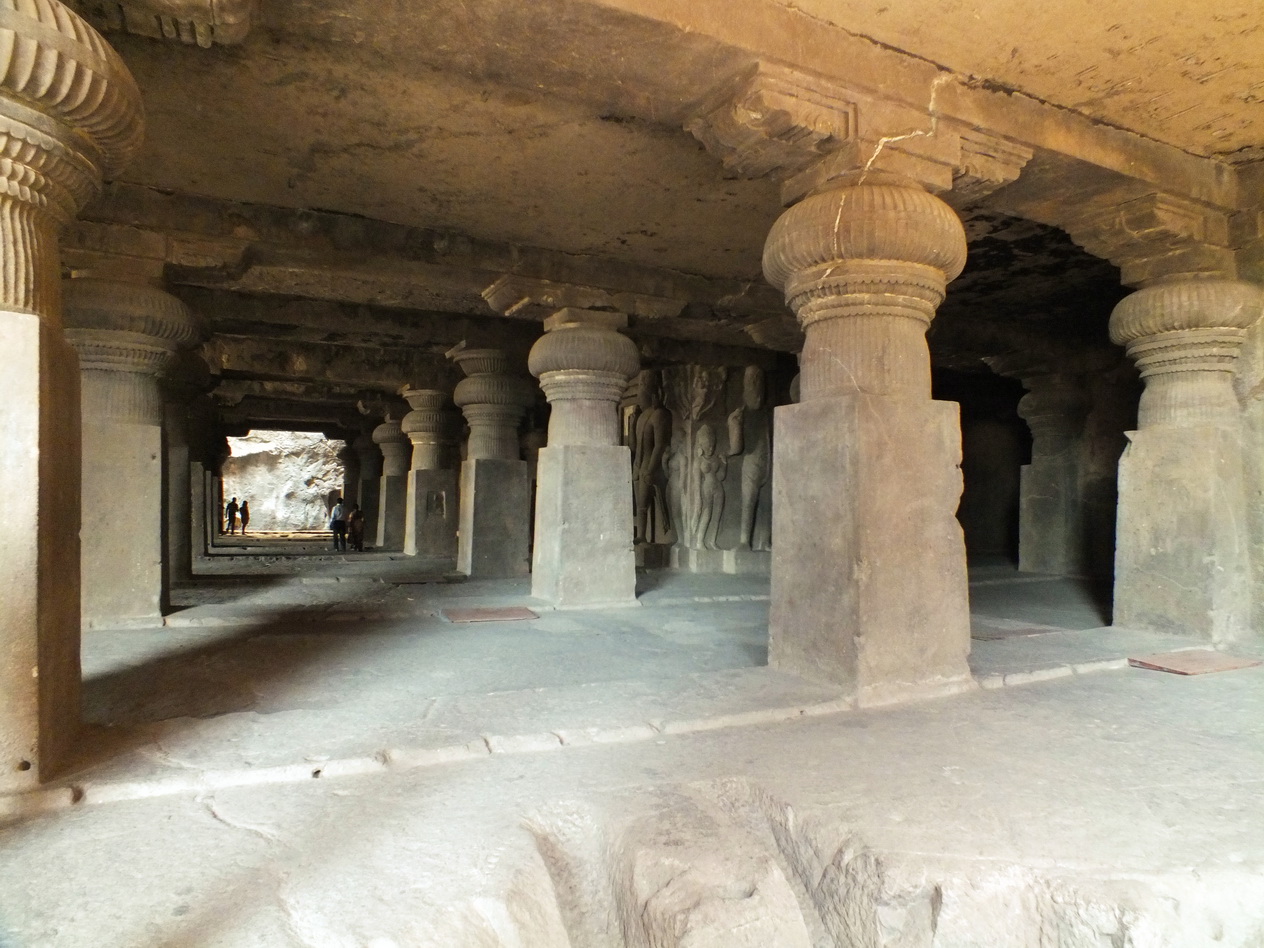
The most outstanding of early caves is located on the small island of Elephanta, outside Mumbai. It is dedicated to Lord Shiva. This is the most elaborate and important large pillared excavation with more than 16,000 square feet of floor space, depicting various aspects of Shiva. He is represented in numerous manifestations, such as the Great Ascetic (Yogishvara), Lord of the Dancers (Nataraja), dual male and female aspect (Ardhanarishvara) and the Descent of the river Ganga (Gangahara). Also impressive among the works are the giant door-guardian figures who stand flanking the four portals to the temple. Unfortunately, these figures, and the majority of the relief panels, have suffered extensive damage, from an early Portuguese military garrison.
The scale and magnificence of the main cave suggests that it was a royal commission. The personal characteristics of the three gods are clearly marked on their faces: they have in common a brooding assurance of their supreme divinity. The sculptor was a master able to combine the three heads into a homogenous bust to create a unique effigy. While the broad shoulders seem to belong to the central face, they also meld convincingly with the other two heads in profile. The caves of Elephanta, with the powerful and subtle Trimurti, date to Gupta period, the Golden Age of India.

OM NAMAH SHIVAYA

Sunday, September 20, 2009

Kumbh mela


WATER is the basis of all life on earth. Of the Panchmahabhut or the five natural elements, water is considered to be the key to life. Human beings feel a close affinity to it, since three-fourths of the human body is constituted of water. In this respect, our body is like a microcosm, as the surface of the earth (the macrocosm) is constituted similarly, being three-fourths, water.

The confluence of three rivers Ganga, Yamuna and Saraswati at Prayag stands for the meeting of Ida, Pingala and Sushumna Nadis at Muladhar Chakra known as Yukta Triveni. Kumbha symbolises the arousing of six chakras to reach Ajna Chakra where these three nadis meet again to form the Mukta (Liberation) Triveni for yogis.

The Ganga always flows and rushes very fast to the sound of Gama-Gam (meaning go-go) while the Yamuna moves slowly with a placid flow to the sound of Yam-Yam (meaning control-control). Likewise whether one acts fast in life or acts after deliberate thinking, it must be decided by his knowledge and temperament. And both these aspects should be supported by the invisible Saraswati, the faculty of Jnan (knowledge). The meeting of these three rivers in the spiritual realm represents the three gunas or qualities of the native, i.e. Sattvic or subtle represented by Saraswati; Rajasic or the vibrant Ganga; and Tamasic or the dark Yamuna. These three rivers also signify the three saktis, Mahalakshmi, Mahakali and Mahasaraswati; the three sacred fires of sacrifice; the three Gods Brahma, Vishnu and Mahesh; and the three notes of music, Sa for Saraswati; Re for Yamuna; and Ga for Ganga.

Further deep in the spiritual sphere, these three rivers represent the three phases of time i.e. present, past and future; the triangle or minimum space enclosed in time; Nad, Bindu and Kala; and the three humours, vata, pitta and kapha. The Triveni also denotes the three basic philosophies of the Gita, i.e. Jnan Yoga, Karma Yoga and Bhakti Yoga.

The Kumbha occurs in a cycle of every 12 years - the most sacred or auspicious time is calculated on the basis of a specific planetary configuration, considering its cosmobiological effect on the human body and mind. Various astronomical conjugations during Kumbha represent various stages of the solar cycle which has a direct influence on human beings and the biosphere. The ritual bath or snan on specific days i.e. full moon, new moon and Basant Panchami have been specifically prescribed on the basis of the bio-effects of lunar phases. The imposed electromagnetic fields on water are transmitted into the human beings taking bath in the Holy Prayag giving them great health benefits. The number 12 here signifies time or Kal as there are 12 adityas, 12 zodiac signs, 12 months, and 12 Jyotirlingas (self-emergent sivalingas). The entire world exists in time, moves in time and space, and is controlled by time. According to Atharvaveda, Kumbh is the representation of space situated in Kal supervising all of us. Spiritually the holding of Kumbha at an interval of 12 years symbolises the need for purifying the body by sublimating the inherent vices of the 12 sense organs, i.e. Panchkarmendriyas (five organs of action), Panchjnanedriyas (five organs of perception, the mind and the intellect - and thereby to arouse the six psychic centres or chakras separated from each other at a distance of 12 angulas for attaining the Amrit Kumbha or pitcher of nectar.

There is another mystical explanation of the Kumbha. The human head and neck form an inverted pitcher or Kumbha from where Amrit or nectar flows downwards into the body. The two eyes represent the sun and moon gods, the nostrils represent Ganga and Jamuna, the tongue is Vani or Saraswati and it spans 12 angulas of space.

Astrologically during Kumbha the three grahas, Jupiter, Sun and Moon, play a prominent role in the two Zodiac signs, Taurus and Capricorn respectively. The presence of Sun in Capricorn or Makara signifies the Swadhishtan Chakra, the centre of procreation representing the water element. Makara also signifies the Kama as Kamdev, popularly knows as Makaradhwaj. It is therefore that one of the famous Shahi Snans occurs on Basant Panchami, the day of Kamdev. Likewise Jupiter's or Jiva's (life force) presence in Taurus signifies the creative power of universe, Shiva Shakti or the Male and female forces.

Friday, January 30, 2009

Triveni Sangam


Triveni Sangam is the confluence of three rivers (Ganga, Yamuna and the legendary Saraswati River) near Allahabad, India. The Triveni Sangam in Allahabad is a confluence of 2 rivers, the Ganga, Yamuna. Of these three, the river Saraswati is invisible and is said to flow underground and join the other two rivers from below. The point of confluence is a sacred place for Hindus. A bath here is said to wash away all one's sins and free one from the cycle of rebirth. The sight of the Sangam is a treat to the eyes. One can see the muddy and pale-yellow waters of Ganga merging with the blue waters of Yamuna. The Ganga is only 4 feet deep, while Yamuna is 40 feet deep near the point of their nexus. The river Yamuna merges into the Ganges at this point and the Ganges continues on until it meets the sea at the Bay of Bengal. At the confluence of these two great Indian rivers, where the invisible Saraswati conjoins them, many tirtha yatris take boats to bathe from platforms erected in the Sangam. This, together with the migratory birds give a picturesque look to the river during the kumbh, in the month of January. It is believed that all the gods come in human form to take a dip at the sangam and expiate their sins.
The Triveni Sangam is believed to be the same place where drops of Nectar fell from the pitcher, from the hands of the Gods. So it is believed that a bath in the Sangam will wash away all one's sins and will clear the way to heaven. Devout Hindus from all over India come to this sacred pilgrimage point to offer prayers and take a dip in the holy waters. The sacred Kumbh Mela is held every 12 years on the banks of the Sangam. According to myth, the Prakrista Yajna was performed here by Lord Brahma. That is how Allahabad received its ancient name, Prayag. Allahabad is also called Tirtha-Raja (Prayag Raj), king of all holy places. It is said that Lord Rama visited Allahabad when he was in exile.
Sangam means confluence, a meeting point of two or more rivers, a place where diverse cultures meet and flow together, a place where people of different origins, different cultures merge into one whole combined identity.